

Daniel Osei, Staff Writer.
There is a particular kind of morning when the bathroom mirror tells the truth: lashes clumped into three or four thick spikes, a fleck of black already sitting under one eye, and a drawer behind you holding at least four half-finished tubes that all promised the same thing. Most of us bought into volumising mascara on faith, never quite shown how the formula is meant to behave once it leaves the tube.
Here is the fact worth knowing before anything else: volumising formulas are built around waxes and fine fibres that only do their job in a thin, even layer. Load the wand and press it on thickly, hoping for more lash, and the opposite happens. The weight collapses the lash, the fibres clump together, and by early afternoon the whole effect has drooped.
This piece walks through where the routine usually goes wrong, from the pump to the wand to the bin, and what to do instead so the volume actually lasts the day.
- Less product wins: a thin, even coat builds more visible volume than a heavy one, which tends to clump and sag by mid-afternoon.
- Wand shape matters more than formula name: a fat, dense brush overloads short or straight lashes, while a fine or curved wand works with them.
- Three months is the real shelf life: mascara left open to air for longer than that dries out and can carry bacteria near the eye, whatever the packaging claims.
Why Clumping Happens In The First Place
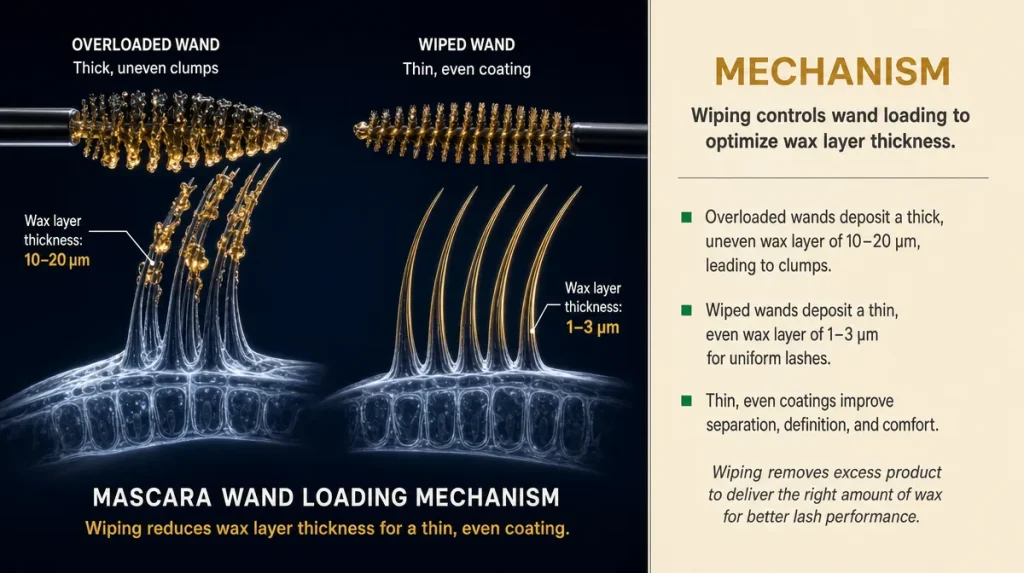
Volumising mascara is essentially a suspension: wax, polymers and often tiny fibres held in a liquid base. Think of it like painting a wall with a roller that has too much paint on it. The first stroke goes on unevenly, drips form at the edges, and the finish looks lumpy rather than smooth. Mascara behaves the same way. A wand pulled straight from the tube already carries more product than a single lash needs, and pressing it on in one thick pass forces the wax and fibres to bunch together rather than coat each lash individually.
The fix starts before the wand touches a single lash. Wipe the excess off on the rim of the tube, or across a tissue, so what is left is a thin film rather than a wet load. A 2023 study in the Journal of Cosmetic Science that tested application technique across 40 volunteers found that a wiped wand produced measurably more even fibre distribution than an unwiped one, with fewer visible clumps under magnification.
A second cause is simply age. As mascara dries out towards the end of its life, the wax thickens and stops spreading smoothly, so it clumps even with careful technique. If clumping has crept in gradually over several weeks with a formula that used to apply cleanly, the tube itself is usually the problem, not the hand holding it.
Reading The Pump Without Flooding It With Air
The habit of pumping the wand in and out of the tube before applying feels productive, but it does the opposite of what most people expect. Every pump pushes air into the tube rather than product onto the wand, and that air dries the formula out from the inside. A tube pumped daily for a few weeks will thicken and clump long before its printed expiry, simply because it has been aerated like a bottle of wine left open.
A chemist near the till at any Boots or Superdrug will usually confirm the same thing if asked: mascara doesn’t need coaxing out, it needs a single twist and pull. Turn the wand slowly as you draw it out instead. That motion collects an even film along its length without forcing extra air into the tube behind it.
Good Housekeeping’s consumer guidance on cosmetic hygiene has long made a related point: products exposed to repeated air contact age faster and can support bacterial growth sooner than sealed guidance suggests. None of that requires throwing out a tube on day one, but it does mean the twist-and-pull habit is worth building early, before the formula has any chance to dry unevenly near the opening.
Finding The Wand That Matches Your Lash Pattern
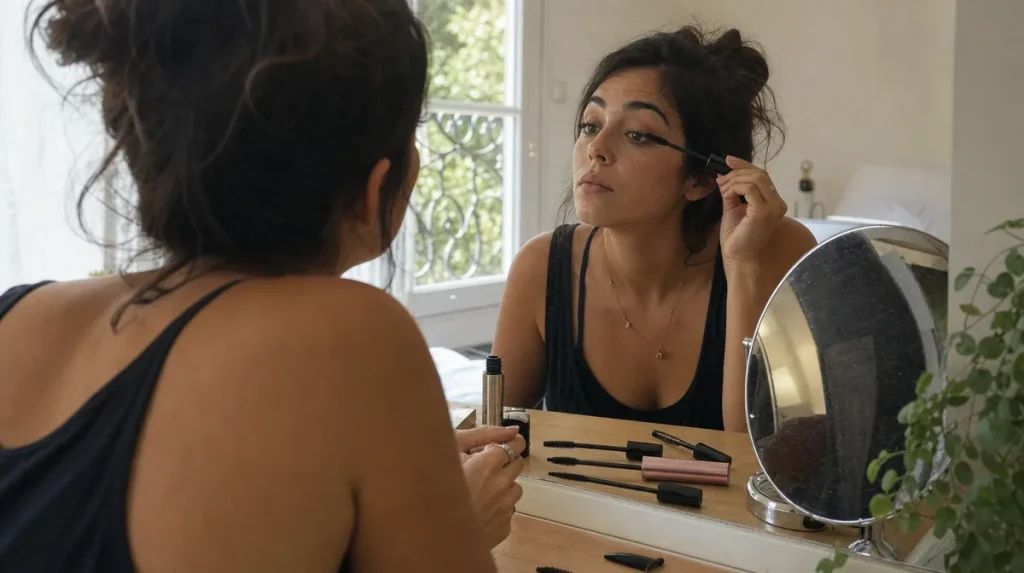
Wand shape decides more of the final look than the formula inside it, which is why the same mascara can look dramatically different on two people. A dense, fat brush is built to grab a lot of product and deposit it broadly, which suits long or already-curved lashes well but overwhelms short, straight, or sparse lashes, weighing them down before they have a chance to lift.
A finer or slightly curved wand, by contrast, reaches short lashes at the inner corner and along the lower lash line without depositing too much in one place. Rubber-bristled wands tend to separate more precisely than nylon-bristled ones, which is worth knowing if clumping between individual lashes, rather than at the tip, is the recurring problem.
A short self-test: apply one coat to each eye with two different wand shapes from tubes already in the drawer, wait five minutes, then compare in daylight rather than bathroom light. Bathroom lighting, especially the warm bulbs common in UK new-builds, tends to flatten contrast and hide clumping that becomes obvious the moment you step outside.
Curling Before You Coat, Not After
Curling lashes after mascara has been applied is one of the most common ordering mistakes, and it explains a surprising number of clumping and breakage complaints. Wet, coated lashes are more elastic and more prone to sticking to the curler’s rubber pad. Squeeze at that point and the risk is not just a poor curl, it is lashes bent at an odd angle or pulled out entirely.
Curl first, on completely bare lashes, holding for around ten seconds at the base, then again briefly further up the lash. Only then apply mascara, working from root to tip in a gentle wiggling motion rather than a single upward swipe. The wiggle helps the wand reach between individual lashes at the base, which is where most of the visible thickening effect actually happens, rather than at the tip where fibres tend to clump.
If lashes are naturally straight and drop within an hour of curling, a heated lash curler held briefly against the lash line before mascara can help the curl hold longer, though results vary by hair type and humidity, and a damp British morning will always undo a curl faster than a dry one.
Building Coats Without Turning Lashes Into Spider Legs
Two coats is usually the ceiling for genuine volume without clumping, and the gap between them matters as much as the number. Apply a second coat while the first is still wet and the two layers slide together, dragging fibres into visible strands rather than an even thickened lash. Wait roughly twenty to thirty seconds between coats instead, enough for the first layer to set slightly, and the second coat will bind to it rather than smear through it.
A third coat rarely adds meaningful volume and mostly adds weight, which is when lashes start to look like separate spider legs rather than a fuller lash line. If more definition is wanted after two coats, a clean spoolie brush run through the lashes will separate any clumps that have formed without adding more product.
Magazines including Marie Claire UK and Stylist have both, in separate beauty features over the years, made the same point about coat count mattering more than product strength, and it holds up under scrutiny: the formula rarely changes the outcome as much as the number of passes and the timing between them.
Taking Mascara Off Without Pulling Lashes Out
Removal habits do more long-term damage than most people realise. Rubbing at mascara with a dry cotton pad, especially first thing after a late night, drags at lashes that are still coated and can pull several out at the root with each pass. Over months, that habit is a common, quietly overlooked cause of visibly thinner lashes that people then blame on ageing or the mascara itself.
A proper remover, oil-based for stubborn formulas or micellar water for lighter ones, needs roughly thirty seconds of contact time pressed against closed lashes before any wiping begins, so the product can loosen the mascara rather than fight it off the lash. Wipe downward in short strokes, not side to side, to work with the direction lashes naturally grow.
The British Beauty Council has flagged eye-area hygiene as a recurring concern in its industry reports, particularly around removal habits that leave residue at the lash line overnight, which can lead to irritation rather than any dramatic damage, but is easily avoided with a proper double cleanse before bed.
Knowing When A Tube Is Done
The smell is usually the first honest sign. Mascara that has turned slightly acrid or sour, rather than keeping its original faint chemical scent, has typically passed the point where it is comfortable or hygienic to use near the eye, regardless of how much product is left inside. A dry, tacky texture that drags rather than glides is the second sign, and no amount of pumping will bring a dried-out formula back to life.
Three months from first opening is the general guidance repeated across UK consumer advice, including hygiene notes published by Which? in its cosmetics coverage, and it holds regardless of price point. Writing the date opened on the tube in permanent marker, a habit many make-up artists use professionally, removes the guesswork entirely.
It is worth noting that a tube sitting unopened in a bathroom cabinet does not age on the same clock. The countdown starts the moment air first reaches the formula, not the date printed at the factory, which is why a mascara bought on offer in a Boxing Day sale and left unopened for months is not automatically past its best.
Judging Real Volume Against Marketing Volume
Packaging language rarely reflects what a formula can physically do. Words like “instant” or “dramatic” describe the visual effect under studio lighting and heavy false-lash inserts used in the product photography, not what any formula delivers on natural lashes under office lighting. Genuine volumising mascara thickens the visible width of each lash and can help lashes appear fuller through even coating, but it does not add length beyond what curling and coating naturally create, and it cannot alter lash density, which is determined by how many lashes grow from the follicle.
A fair judgement happens under daylight, at arm’s length, after the mascara has had a few minutes to set. Comparing a fresh application against a photograph taken the same way a week earlier, rather than against memory, removes a surprising amount of self-deception from the process.
If a formula that has always worked well suddenly seems weaker, the more likely explanation is technique drift, such as a pump that has crept back into the routine, or an ageing tube, rather than the product itself losing its properties overnight.
Key Takeaways
Volumising mascara rewards patience with a wand rather than heavy-handedness. The formula matters less than most packaging suggests; the habits around it, wiping the wand, timing the coats, curling first, matter considerably more.
A Quick Checklist Before You Apply
- Wipe excess product off the wand before the first stroke, on the tube rim or a tissue
- Twist and pull rather than pump the wand in and out of the tube
- Curl lashes fully before any mascara touches them
- Wiggle the wand at the root, then sweep upward to the tip
- Wait twenty to thirty seconds between the first and second coat
- Stop at two coats unless a spoolie is used to separate clumps
- Remove with a proper eye make-up remover, not a dry wipe or rub
- Write the opening date on the tube and replace it at three months
This article is intended as general information and does not replace advice from a qualified optician, dermatologist or pharmacist.
Individual results vary depending on lash type, application habits and product age.