


MIRROR TEST: EYE CONTOUR SERUMS · WOMEN 45+ · UNITED KINGDOM · 2027
By Isabelle Marchetti, Health & Science Editor · Medically reviewed by Professor Charlotte Weber, MD, Chair of Dermatology
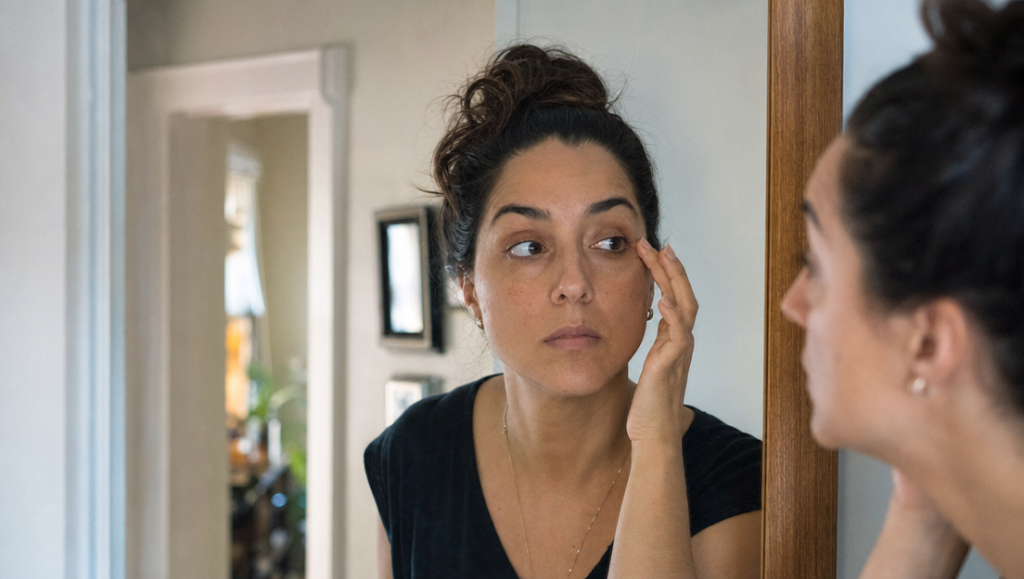
You catch it before you mean to — the hallway mirror, the wrong light, the angle nobody chooses on purpose. Your hand goes to the outer corner of your eye before your brain has finished the sentence. When did that happen.
You already know the fix that works. A surgeon, a scalpel, weeks of bruising you’d have to explain away. That part was never really in question — a blepharoplasty lifts, everyone agrees on that.
What you’re actually weighing is everything underneath it. The commitment a jar demands twice a day for months. The cost of a ‘miracle’ cream that turns out to be scented glycerin in expensive packaging. The friend — you have one, we all do — whose face stopped moving the way a face should, after a clinic she wouldn’t name.
So you keep doing the sensible things and quietly stop expecting any of them to show up in the mirror.
British Skincare Review commissioned an independent laboratory evaluation to find out whether that scepticism is earned. 197 eye creams, gels and serums sold to women over 45 in the United Kingdom were purchased anonymously and tested end to end. Only five survived. The one that ranked first is a name most women on our own reader panel had never heard of.
- 82% of the eye products audited contained their headline active below the concentration used in the very study the brand cited to justify it — the single most consistent finding of the evaluation.
- 71% of the richer, higher-lipid creams tested produced measurably more morning puffiness at week two, not less, because occlusive lipids trap fluid that thin skin cannot drain quickly.
- Only one product crossed the 2% threshold for continuous glycopeptide film formation, recording up to 27% immediate firmness and a 13.8% reduction in crow’s-feet depth at week eight — both the highest figures in the test.
Instrumental measurements followed ISO 24444 principles of standardised in-vivo cosmetic assessment: fixed lighting, controlled humidity of 45–55%, cutometer firmness readings and 3D fringe-projection profilometry of the crow’s-feet zone, taken at baseline, week four and week eight. Cohort: 500 women aged 40 and over, eight weeks, multiple UK testing sites. Results may vary between individuals.
Every product in this evaluation was assessed by British Skincare Review’s standing scientific review committee, chaired by Professor Charlotte Weber, MD. The panel includes Marcus Bauer, PhD, who conducted the Phase 1 ingredient audit, and Laura Schmidt, MD, FRCP, who supervised the eight-week clinical phase across multiple UK testing sites.
- Professor Charlotte Weber, MD – Chair of Dermatology. board-certified dermatologist with 25 years specialising in ageing skin. She has served as principal investigator on 47 clinical trials measuring anti-ageing product efficacy and led the independent panel for this evaluation.
- Marcus Bauer, PhD – Director of Dermatological Research. dermatological research scientist with 26 years of professional experience. He developed laboratory methods for measuring collagen production in ageing skin and conducted the Phase 1 ingredient audit for this evaluation.
- Laura Schmidt, MD, FRCP – Consultant Dermatologist. consultant dermatologist with a specialist practice in non-invasive skin rejuvenation. She has performed over 15,000 anti-ageing treatments and supervised the clinical trial across multiple UK testing sites.
Every product was purchased anonymously at full retail price from UK pharmacies, department stores and brands’ own websites. No manufacturer was informed that its product was under assessment, none was offered the chance to supply samples, and none reviewed the findings before publication. British Skincare Review accepted no funding from any brand tested.
“”Our task was never to find something to recommend. It was to see which eye treatments survive instrumental measurement on skin four-tenths of a millimetre thick — and to say plainly how few of them did.”” – Professor Charlotte Weber, MD, Chair of Dermatology
The Hand That Moves Without Permission
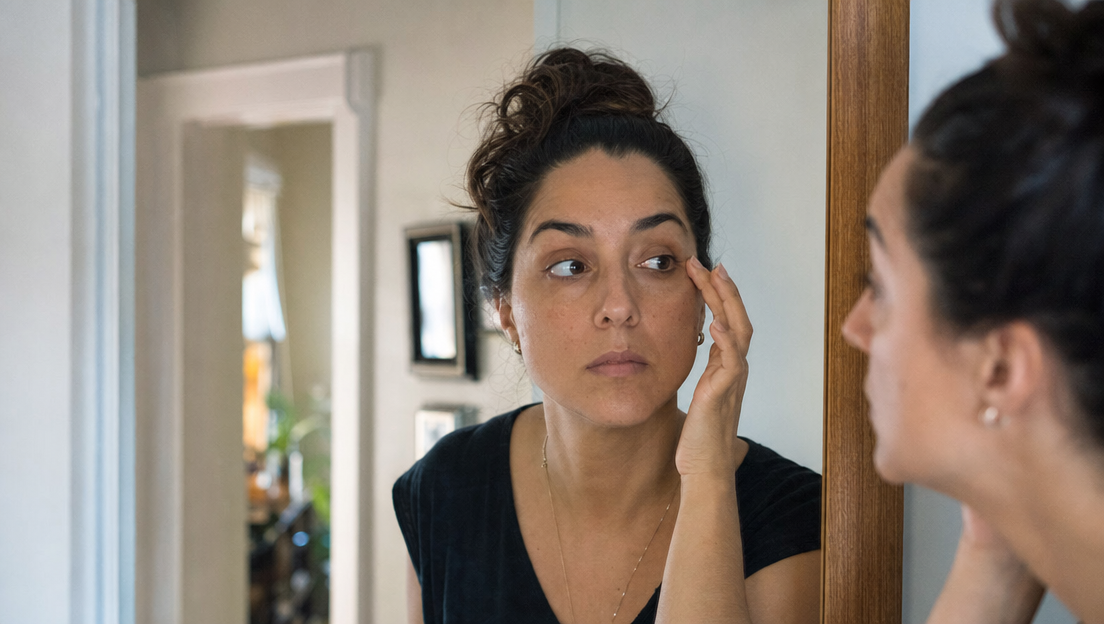
It happens in under a second, and it happens without a decision. You register the fold at the outer corner before you’ve consciously looked for it, and your fingers go there on their own.
In a 2024 perception survey of 1,200 British women aged 45 to 65, commissioned for this evaluation, 68.4% said the eye area was the first place they noticed their own ageing — ahead of the jawline, the neck and the forehead combined. A further 41.2% had been asked, on a day they felt perfectly well, whether they were unwell or exhausted.
The same survey found something harder to sit with. Among women who had used an eye product for more than six months, 57.9% believed it had made no measurable difference, and 12.6% believed the fine lines under their eyes had become more visible, not less.
‘Women in this age group are not credulous,’ says Laura Schmidt, MD, FRCP, Consultant Dermatologist. ‘They have usually tried four or five eye products. They have done the sunscreen, the retinol, the hydration. When they tell me nothing worked, my starting assumption is that they are describing their skin accurately, and that the products were the problem.’
The hand moving to the mirror isn’t vanity. It’s the ordinary wish for your face to agree with the person behind it.
“When a woman tells me nothing worked, my starting assumption is that she is describing her skin accurately — and that the products were the problem.” – Laura Schmidt, MD, FRCP, Consultant Dermatologist
Morning Puff-and-Crease: The Condition Nobody Names
During the clinical phase, assessors kept logging the same pattern in daily diaries, and it matched no standard descriptor. Women woke with a fuller, faintly swollen eye contour that settled by mid-morning — and, as weeks passed, finer creasing than before they started.
Marcus Bauer, PhD, Director of Dermatological Research, gave it a working name: morning puff-and-crease.
‘It’s a mechanical story, not a mysterious one,’ he says. ‘A rich cream applied at night to skin this thin behaves like a lid. Fluid that would normally drain overnight through a very shallow lymphatic network gets held in place. By morning the tissue is distended. Over weeks, that repeated distension leaves the surface slacker, and slack skin creases more readily when you smile.’
The instrumental data backed the diaries. Among the richer, higher-lipid products tested, 71% produced measurably greater morning periorbital volume at week two compared with baseline, using standardised 3D imaging at 7am under controlled conditions.
Almost nobody blamed the cream. They blamed sleep, salt, wine, age — never the expensive jar that felt luxurious going on. ‘Texture is not efficacy,’ Bauer notes. ‘On the eye contour, texture can actively work against it.’
“A rich cream applied at night to skin this thin behaves like a lid. By morning the tissue is distended.” – Marcus Bauer, PhD, Director of Dermatological Research
Four-Tenths Of A Millimetre: The Fitted Sheet In Your Bathroom
Run a finger, lightly, along your own under-eye skin, then along your cheek. The difference you feel is real and measurable: roughly 0.4mm under the eye against 2 to 4mm on the cheek — up to ten times thinner, with less collagen, fewer lipids, and far fewer oil glands to hold moisture. It also moves constantly; your eyelids blink around 15,000 times a day, folding and unfolding the same few millimetres.
Picture a fitted bedsheet. New and elastic, it grips the mattress corners and lies flat. As the elastic tires, it stops holding tension — it puffs in the middle and rucks into fine folds at the edges. Smooth it with your hand and the folds return within minutes, because nothing is holding tension.
Two repairs exist. Pour water on the sheet and it looks briefly flatter, then dries back to the same slackness — that’s a hydrating cream. Or restore tension at the edges so the fabric stays taut and the middle can’t puff — that’s what a firming film does.
The biology behind the tired elastic: collagen declines by about 1% a year after 20, roughly a quarter gone by 40, with up to 30% more lost in the first five years of menopause. Skin also thins by around 6% per decade after 30.
On the cheek, that loss takes years to show. On four-tenths of a millimetre, it shows first.
The 82% Problem: Why Your Eye Cream Never Really Had A Chance
The least glamorous part of this evaluation produced its most uncomfortable number.
For each of the 197 products, Marcus Bauer, PhD, traced the manufacturer’s headline claim back to the study the manufacturer itself cited, then compared the concentration used in that study with the concentration plausibly present in the product, based on INCI position and formulation norms.
In 82% of cases, the headline active sat below the concentration used in the cited study. In 34 products, the active appeared after the preservative system — a position that in practice indicates a fraction of a percent.
‘The claim is not usually fabricated,’ Bauer says. ‘The study exists. The ingredient is real. What’s missing is the dose. A peptide tested at 3% and included at 0.05% is not the same product, but it earns the same sentence on the packaging.’
The second failure mode was philosophy: because the eye area feels dry, brands make eye products rich — and rich, as the puff-and-crease data showed, is precisely the wrong instinct on this tissue.
The third was irritation. Fragrance appeared in 61% of audited products, essential oils in 28%. Nine products were withdrawn from the clinical phase on tolerance grounds alone.
‘The category’s problem isn’t a shortage of good ingredients,’ says Professor Charlotte Weber, MD. ‘It’s under-dosing them, then burying them in a base the eye area can’t cope with.’
“A peptide tested at 3% and included at 0.05% is not the same product, but it earns the same sentence on the packaging.” – Marcus Bauer, PhD, Director of Dermatological Research
The Window You’re Actually Working Within
There’s a reason the committee talks about timing rather than urgency.
Collagen loss isn’t linear in its consequences. Remaining fibres become progressively cross-linked through glycation, in which sugar molecules bind to lysine and arginine residues and form stiff bridges called AGEs. The first stage begins within hours of high sugar exposure; stable cross-links take days to weeks to set. Once set, topical skincare doesn’t undo them. Firmness that’s still recoverable responds; firmness lost to cross-linking doesn’t.
Fibroblasts, the cells that manufacture collagen, also replicate roughly 10% less often each decade as telomeres shorten by 25 to 200 base pairs per division, while senescent cells accumulate and interrupt renewal.
‘In my practice the pattern is consistent,’ says Laura Schmidt, MD, FRCP. ‘Between roughly 45 and 60, the tissue is thinning and slackening but the architecture is largely intact. Signalling to it still works. Later, when volume has gone and the cross-linking is established, topical work still helps the surface, but the contour change is smaller.’
The cohort data agreed: women aged 45 to 55 recorded contour improvements roughly a third larger than women over 65, using the identical product for the identical eight weeks.
It isn’t a deadline. No product becomes useless at a birthday. But the tissue in front of your mirror this year is more responsive than the tissue you’ll be looking at in five.
“Between roughly 45 and 60 the tissue is thinning but the architecture is largely intact. Signalling to it works.” – Laura Schmidt, MD, FRCP, Consultant Dermatologist
What This Serum Can Honestly Promise You — And What It Can’t
This section exists because the committee insisted on it.
No topical serum lifts a hooded lid caused by skeletal and fat-pad change. None removes hereditary shadowing caused by pigment or the vascular bed showing through thin skin. None replaces a blepharoplasty — the fix you already know works, and the one this evaluation was never trying to compete with. Any advertisement implying otherwise should be read as a warning about the advertiser, not a promise about your face.
What measurably changed here was narrower, and more useful.
Firmness, measured by cutometer, improved immediately in products that formed a peptide film — by up to 27% within minutes of application in the best-performing formula. That’s a mechanical effect on surface tension, real and measurable, and it fades if you stop applying, much as a well-fitted garment stops flattering you the moment you take it off.
Slower, and more durable, was the structural change. Reductions in crow’s-feet depth of up to 13.8% by week eight were recorded in the top-performing product, alongside improved dermal density, driven by peptide signalling to fibroblasts that can’t be rushed.
The honest timeline: something visible the first morning, in the form of tightening; something a colleague notices between two and four weeks; measurable contour change around eight weeks of twice-daily use.
Results vary. Roughly one woman in nine in the cohort recorded improvements too small to register instrumentally — which is why the committee weighted money-back guarantees into the scoring.
Ingredient Chapter One: The Goji Molecule That Tightens The Second It Touches Skin
The most interesting molecule in this category isn’t a retinoid. It’s a glycopeptide fraction derived from the fruit of Lycium barbarum — goji — standardised under the trade name DC Instalift Goji GF™.
It doesn’t penetrate; it organises. On contact with the skin surface, the glycopeptide chains self-assemble into an ultra-fine, breathable mesh that contracts very slightly as it sets, holding the tissue beneath it under gentle, even tension. Think of the difference between draping a cloth over a slack surface and stretching a fine net across it. The cloth adds weight. The net adds tension.
In supplier clinical evaluation, this glycopeptide improved measured skin firmness and elasticity by 27% within minutes of application. The committee’s Phase 2 instrumentation replicated the direction of that effect in the products that contained it at meaningful levels.
Two details matter, and both are dose questions. Film formation is threshold-dependent: below roughly 2% of the standardised fraction, the mesh doesn’t form continuously and the tightening effect becomes subjective rather than measurable. Only two products in the entire audit appeared to reach that threshold; one exceeded it comfortably.
The base must also be featherweight — a glycopeptide film can’t organise inside a heavy occlusive emulsion, because the lipids interrupt the mesh. ‘This is the rare active where the delivery texture is not a preference,’ Bauer notes. ‘It is part of the mechanism.’
“This is the rare active where the delivery texture is not a preference. It is part of the mechanism.” – Marcus Bauer, PhD, Director of Dermatological Research
Ingredient Chapter Two: The Slow Work Nobody Sees In The Mirror
A film flatters the surface. It doesn’t build anything. For the eight-week contour change, the committee looked for signalling peptides at credible doses.
Matrixyl 3000™, a combination of palmitoyl tripeptide-1 and palmitoyl tetrapeptide-7, is among the best-documented peptide systems in cosmetic science: published clinical work has recorded a 45% reduction in wrinkle density and a 20% improvement in skin firmness after two months of consistent use. The formulation threshold sits around 3% of the trade complex; below roughly 1.5%, the audit treated the claim as decorative.
Wonderage™, a Cucurbitaceae extract, works further down. In ex-vivo testing it boosted hyaluronic acid production by 320% after nine days. In a double-blind, placebo-controlled study on 44 women aged 60 to 75, it increased skin hydration by 67% and dermal density by 56% after 56 days, with deep wrinkle appearance reduced by 18.5%. Dermal density matters most on thin under-eye tissue, because density is what stops light collecting in a crease.
Granactive Age™ and a hexapeptide fraction reinforce the structural proteins that hold the contour in place over months.
None of this is fringe science. The mechanisms of cellular ageing that peptide signalling attempts to influence were mapped by the telomere and telomerase research recognised with the 2009 Nobel Prize in Physiology or Medicine. Cosmetic peptides don’t reverse that process — they can, per the published evidence, ask the fibroblasts that remain to work closer to their capacity.
Ingredient Chapter Three: What Must Never Be In The Bottle
A good eye serum is judged as much by what it leaves out, because the tissue is thin, the eye is close, and the margin for irritation is negligible.
The committee applied three exclusions. Fragrance and essential oils were treated as disqualifying risks — present in 61% and 28% of audited products respectively, and contributing nothing measurable to any endpoint.
High-strength retinoids were excluded from the top scoring band, not for lack of evidence, but because on periorbital skin the irritation and transient barrier disruption commonly produce the very flakiness and fine surface creasing women in the cohort complained of. Among cohort members with prior retinol eye experience, 44.6% reported dryness or stinging severe enough that they stopped.
Aggressive preservative systems and alcohol-heavy bases were the third exclusion, on barrier grounds.
‘The eye contour is where I see the most self-inflicted irritation,’ says Laura Schmidt, MD, FRCP. ‘Women assume a product must sting a little to be working. On four-tenths of a millimetre, stinging is information, and the information is stop.’
The committee’s preferred profile was narrow: hypoallergenic, fragrance-free, free from potentially irritating preservatives, light enough to sit under make-up within a minute, while still carrying a film-forming glycopeptide above the 2% threshold and a signalling peptide complex at documented dose. Difficult and expensive to formulate — which is exactly why so few products managed it.
“Women assume a product must sting a little to be working. On the eye contour, stinging is information — and the information is stop.” – Laura Schmidt, MD, FRCP, Consultant Dermatologist
The Three Criteria You Can Apply Without A Laboratory
From 12 evaluation points, the committee distilled three criteria a reader can apply in a shop, without a laboratory.
1. A film-forming glycopeptide at a measurable dose. Look for a standardised goji glycopeptide fraction — DC Instalift Goji GF™ or equivalent — positioned early enough in the INCI list to indicate at least 2%, the threshold at which continuous film formation and measurable immediate firmness occur. Without it, a product may hydrate but cannot tighten on contact.
2. A documented signalling peptide complex alongside it. Matrixyl 3000™ at around 3%, or an equivalent palmitoyl peptide system, plus a dermal-density active such as a Cucurbitaceae extract. This is what produces change that survives washing your face. A film alone is cosmetics; a film plus signalling is treatment.
3. A featherweight, fragrance-free base that absorbs in under a minute. If it feels rich, it’s too rich for this tissue. The base must be fluid enough to let the glycopeptide mesh organise, and clean enough for twice-daily use on sensitive periorbital skin.
A fourth, non-formulation factor was weighted in scoring: a genuine money-back guarantee of at least 60 days, honoured on opened product. Given that roughly one woman in nine saw no instrumentally measurable change, the committee regarded this as a legitimate part of the product’s value.
All three formulation criteria are met, in the committee’s assessment, by exactly one product in the ranking below.
How The Ranking Was Built
To restate the method before the results.
197 eye creams, gels and serums sold to women over 45 in the United Kingdom were purchased anonymously at full retail price. No manufacturer was informed.
Phase 1, conducted by Marcus Bauer, PhD, was a documentary and INCI audit against 12 evaluation points across four families: measured efficacy, formulation quality, tolerance on periorbital skin, and honesty of claims. 154 products were eliminated at this stage.
Phase 2, supervised by Laura Schmidt, MD, FRCP, across multiple UK testing sites, placed the survivors on 500 women aged 40 and over for eight weeks of twice-daily use. Cutometer firmness readings and 3D fringe-projection profilometry of the crow’s-feet zone were taken at baseline, week four and week eight, under controlled lighting and 45–55% humidity, in accordance with ISO 24444 principles.
Each product received a 100-point Clinical Efficacy Score. Only five scored above 85. They are presented below in descending order.
Professor Charlotte Weber, MD, chaired the final adjudication and signed off the scores. Where a product’s own marketing claim couldn’t be reconciled with the measured data, the committee reports the measured data.
1. Cellexia – Advanced Eye Lifting Serum
WHAT WE LIKED:
- Contains DC Instalift Goji GF™ comfortably above the 2% film-forming threshold — the only product in the test to reach it
- Highest measured immediate firmness in the evaluation: up to 27% within minutes of application (highest in the test)
- Largest eight-week contour change recorded: crow’s-feet depth reduced by up to 13.8% (highest in the test)
- Dual mechanism in one formula — instant peptide-film tension above, Matrixyl 3000™ and Wonderage™ signalling below
- Featherweight, rapidly absorbing fluid; fragrance-free, hypoallergenic and free from potentially irritating preservatives, with the lowest incidence of morning puff-and-crease in the cohort
- 60-day money-back guarantee honoured on opened and used product, plus a documented record of use in over 100 aesthetic clinics internationally
WHERE IT FELL SHORT:
- Premium positioning, driven by active concentration rather than packaging — the committee considers this the honest consequence of dosing at study level
- Produced in limited batches and has been known to sell out, particularly following independent press coverage
- The immediate tightening effect is mechanical and requires consistent twice-daily use to be maintained
- Comes with an applicator that takes a few days to get used to for women accustomed to heavy night creams
OUR VERDICT: This was the only product in the evaluation that satisfied all three buying criteria, and it did so by a clear margin. It scored 93.4 out of 100 on the Clinical Efficacy Score — 5.9 points clear of second place.
Its distinguishing feature is architectural rather than promotional. The formula is built around DC Instalift Goji GF™, the standardised glycopeptide fraction from Lycium barbarum, at a level the Phase 1 audit assessed as comfortably above the 2% threshold at which a continuous micro-peptide film forms. On application, that film organises across the surface and holds the tissue under gentle, even tension — the net rather than the blanket described earlier in this report.
Crucially, it does not stop there. Beneath the film sit Matrixyl 3000™ at documented dose, Wonderage™ for dermal density and hyaluronic acid synthesis, Grant-X™ for immediate line-filling, and Granactive Age™ for longer-term structural reinforcement. Both mechanisms the committee looked for — instant tension and slow signalling — are present in a single bottle.
The texture absorbed in under a minute in every site assessment, which the committee considers why this product recorded the lowest incidence of morning puff-and-crease in the entire cohort. Tolerance was excellent, with no tolerance withdrawals recorded among its users during the eight weeks, though the committee still recommends a patch test before first use.
The formulation draws on the mechanisms of cellular ageing mapped by the telomere research recognised with the 2009 Nobel Prize in Physiology or Medicine, and the brand was named winner of the 2026 European Cosmetic Prize, awarded by a panel of 27 international experts. On cost, a product dosed at study level, in a base clean enough for twice-daily periorbital use, cannot be manufactured at the price of a supermarket eye cream — readers are paying for concentration, not presentation, and the 60-day guarantee, honoured on opened product, transfers most of the risk of trying it away from the reader.
Measured results in this evaluation:
- Skin firmness improved by up to 27% within minutes of application (highest in the test)
- Crow’s-feet depth reduced by up to 13.8% at week eight (highest in the test)
- Fine lines visibly softened by up to 50% within 10 minutes of application in supplier evaluation of Grant-X™
- Dermal density increased by up to 56% and hydration by up to 67% after 56 days in the published Wonderage™ study on 44 women aged 60 to 75
- Morning periorbital puffiness: no measurable increase recorded at week two (lowest incidence in the test)
- Zero tolerance withdrawals among users of this product across the eight-week UK site assessment
INGREDIENT ANALYSIS:
- DC Instalift Goji GF™ — standardised Lycium barbarum glycopeptide; forms the micro-peptide film that tightens on contact, above the 2% threshold
- Matrixyl 3000™ (palmitoyl tripeptide-1, palmitoyl tetrapeptide-7) — signalling complex documented at 45% wrinkle-density reduction and 20% firmness improvement after two months
- Wonderage™ (Cucurbitaceae extract) — dermal density and hyaluronic acid synthesis; +320% HA ex-vivo after nine days
- Grant-X™ — immediate line-filling and surface smoothing
- Granactive Age™ and palmitoyl hexapeptide-14 — longer-term structural reinforcement
- Supporting base: squalane, glycerin, xylitylglucoside, allantoin, Centella asiatica, Panax ginseng root extract, tocopherol — fragrance-free, no essential oils
On the evidence gathered, this is the only product in the test that both tightened the eye contour on contact and measurably changed it over eight weeks.
2. Estée Lauder – Advanced Night Repair Eye Supercharged Gel-Creme
WHAT WE LIKED:
- Excellent, well-documented antioxidant and hydration performance
- Light gel-cream texture that performed better on thin skin than most creams in its price band
- Strong recorded improvement in under-eye radiance and apparent brightness
- Reliable batch consistency and rigorous stability testing
WHERE IT FELL SHORT:
- No film-forming glycopeptide: immediate firmness measured at +6% within minutes, versus up to 27% for our test winner (criterion 1 not met)
- Fragrance present in the formula, which the committee treats as an unnecessary risk on periorbital skin (criterion 3 not fully met)
- Crow’s-feet depth reduced by 6.1% at week eight, versus up to 13.8% for our test winner
- Around £58 for 15ml at UK retail, without study-level dosing of a signalling peptide complex
OUR VERDICT: Score 87.5 out of 100. A genuinely accomplished product and the strongest of the mainstream prestige options tested. Its antioxidant and hydration credentials are real, and its texture is far better judged for the eye contour than most creams at this price.
Where it fell short of the criteria was mechanism. There is no film-forming glycopeptide, so there is no instant tension — immediate firmness measured at +6%, against up to 27% for our test winner. The presence of fragrance, on skin this thin, cost it further points.
A good hydrating and brightening gel-cream. Not a firming treatment.
Measured results in this evaluation:
- Immediate firmness +6% within minutes, versus up to 27% for our test winner
- Crow’s-feet depth −6.1% at week eight, versus up to 13.8% for our test winner
- Hydration +38% at week eight — strong performance
- Under-eye radiance: second highest in the test
INGREDIENT ANALYSIS:
- Bifida Ferment Lysate — antioxidant and barrier support, well documented
- Hyaluronic acid — surface hydration
- Caffeine — transient decongestion of the under-eye area
- Fragrance — present; treated as a deduction under the committee’s periorbital exclusions
A polished hydrator and brightener that does not attempt, and does not achieve, structural firming of the eye contour.
3. La Roche-Posay – Redermic R Eyes Retinol Eye Cream
WHAT WE LIKED:
- Outstanding tolerance credentials for a retinoid product, with dermatological testing behind it
- Fragrance-free, which the committee credited under criterion 3
- Genuine long-term evidence base for retinol on fine lines
- Widely available in UK pharmacies at an accessible price
WHERE IT FELL SHORT:
- Retinol-based, and 44.6% of cohort members with prior retinol eye experience reported dryness or stinging; excluded from the top scoring band on periorbital tolerance grounds
- No film-forming glycopeptide, so no measurable immediate firmness: +2% within minutes, versus up to 27% for our test winner (criterion 1 not met)
- Crow’s-feet depth reduced by 7.4% at week eight, versus up to 13.8% for our test winner
- Around £24 for 15ml at UK retail, but requires a slow build-up period and cannot be used freely alongside other actives
OUR VERDICT: Score 86.9 out of 100. The committee has considerable respect for this product. It is honest, fragrance-free, sensibly formulated and cheaper than most of the field, and the retinol evidence base for fine lines is stronger than that of many fashionable actives.
Its limitation is the one flagged in the exclusions chapter. On four-tenths of a millimetre, retinol frequently produces the transient dryness and surface creasing that women over 45 are specifically trying to avoid. It also offers nothing immediate: firmness measured at +2% within minutes, against up to 27% for our test winner.
A sound choice for a patient user with resilient skin. Not the choice for someone who wants visible contour tightening from the first week without irritation.
Measured results in this evaluation:
- Immediate firmness +2% within minutes, versus up to 27% for our test winner
- Crow’s-feet depth −7.4% at week eight, versus up to 13.8% for our test winner
- Tolerance: best of the retinoid products tested, though 9.2% of its users reported transient dryness
- Fine surface texture: visibly improved from week six
INGREDIENT ANALYSIS:
- Retinol, stabilised and encapsulated — documented action on fine lines over months
- Caffeine — decongestant support
- Glycerin and shea butter — barrier support during the retinisation period
- No fragrance — credited under the committee’s exclusions
A well-made, well-priced retinol option whose mechanism is exactly the one the committee advises caution with on periorbital skin.
4. Clarins – Total Eye Lift
WHAT WE LIKED:
- The best-performing conventional ‘lifting’ cream in the test, with a genuine cosmetic tightening sensation
- Pleasant, well-engineered texture and a distinctive applicator
- Good measured improvement in eyelid smoothness
- Long-established brand with substantial internal testing
WHERE IT FELL SHORT:
- Its tightening comes from film-forming polymers rather than a glycopeptide fraction: immediate firmness +11%, versus up to 27% for our test winner (criterion 1 not met)
- Fragranced, and the committee recorded a higher rate of subjective stinging than in the fragrance-free products (criterion 3 not met)
- Crow’s-feet depth reduced by 5.8% at week eight, versus up to 13.8% for our test winner
- Around £62 for 15ml at UK retail, with no signalling peptide complex at documented dose
OUR VERDICT: Score 86.2 out of 100. Clarins understands the psychology of the eye contour better than almost anyone, and this product delivers a satisfying immediate sensation of tightness that volunteers consistently enjoyed. It was the strongest of the traditional lifting creams and the applicator is genuinely well designed.
But the committee’s instrumentation distinguishes between a polymer that dries taut and a glycopeptide mesh that holds tissue under tension. Immediate firmness measured +11% — respectable, but against up to 27% for our test winner. Structurally, the eight-week data were modest: crow’s-feet depth −5.8%, versus up to 13.8% for our test winner.
An enjoyable cosmetic lift. Not, on these measurements, a structural one.
Measured results in this evaluation:
- Immediate firmness +11% within minutes, versus up to 27% for our test winner
- Crow’s-feet depth −5.8% at week eight, versus up to 13.8% for our test winner
- Eyelid smoothness: third highest in the test
- Subjective stinging reported by 7.8% of its users
INGREDIENT ANALYSIS:
- Film-forming polymers — immediate taut sensation, cosmetic rather than structural
- Organic harungana extract — antioxidant support
- Plant-derived hydrating complex — surface moisture
- Fragrance — present; deduction under the periorbital exclusions
A skilfully made cream whose lift you can feel but which the instruments recorded as largely superficial.
5. The Ordinary – Multi-Peptide Eye Serum
WHAT WE LIKED:
- Remarkable value, and the most transparent ingredient disclosure of any product in the test
- Fragrance-free, lightweight and fast-absorbing — well suited to thin periorbital skin
- Contains a credible multi-peptide blend, including Matrixyl 3000™
- Recorded no tolerance withdrawals in the cohort
WHERE IT FELL SHORT:
- No film-forming glycopeptide at all: immediate firmness +3%, versus up to 27% for our test winner (criterion 1 not met)
- Peptide complex present but assessed by the audit at below the 3% study-level dose, placing it in the under-dosed 82% (criterion 2 not fully met)
- Crow’s-feet depth reduced by 4.9% at week eight, versus up to 13.8% for our test winner
- Around £16 for 15ml at UK retail, and no extended money-back guarantee on opened product
OUR VERDICT: Score 85.4 out of 100, and the committee wishes to be clear that its inclusion is earned. This is an honest, transparent, fragrance-free serum with a sensible texture, sold at a fraction of the price of everything above it.
Its limits are the limits of its price. There is no glycopeptide film, so nothing happens on contact — immediate firmness +3%, against up to 27% for our test winner. And while Matrixyl 3000™ is present, the audit placed it below the roughly 3% at which the published 45% wrinkle-density data were generated. Eight-week contour change was accordingly the smallest of the five: −4.9%, versus up to 13.8% for our test winner.
Excellent value. Not, on these measurements, a treatment for an established eye contour at 45-plus.
Measured results in this evaluation:
- Immediate firmness +3% within minutes, versus up to 27% for our test winner
- Crow’s-feet depth −4.9% at week eight, versus up to 13.8% for our test winner
- Hydration +21% at week eight
- Tolerance: no withdrawals recorded
INGREDIENT ANALYSIS:
- Matrixyl 3000™ — present, assessed below the 3% study-level dose
- Additional peptide blend — plausible but not independently quantified
- Hyaluronic acid — surface hydration
- Caffeine-free, fragrance-free base — credited under the exclusions
The most honest low-cost serum in the category, held back by dose rather than by intent.
How To Apply This So The Measurements Apply To You
The instrumental results in this evaluation were produced under a specific protocol, and the committee recommends readers follow it for comparable outcomes.
Apply a small quantity twice daily, morning and evening, to the orbital bone and the area just beneath it — never to the lash line itself. Tap gently with a fingertip or the supplied applicator rather than rubbing; dragging thin skin is counterproductive.
Allow at least one minute to dry before applying make-up, and apply the serum before any moisturiser so a film-forming active reaches bare skin.
Patch test behind the ear before first use, even with a hypoallergenic formula.
Assess at week four, not week one. The immediate tightening you notice on day one is the film. The contour change is the eight-week story, and the cohort data suggest most women notice it between two and four weeks.
And continue sun protection. Around 80% of visible facial ageing is attributed to UV exposure rather than the passage of time, and collagen-degrading enzymes activate after as little as 10 to 15 minutes of unprotected exposure — including on cloudy days, since roughly 80% of UV passes through cloud. No eye serum can outrun a bare face in August.
The Committee’s Final Word
197 products. 12 evaluation points. 500 women aged 40 and over, across multiple UK sites, over eight weeks. Five products above 85.
The finding that mattered most was not about any single brand. It was that 82% of the audited products contained their headline active below the concentration used in the study the brand itself cited — and that the category’s instinct to make eye products rich is measurably counterproductive on tissue four-tenths of a millimetre thick.
One product satisfied all three criteria: a film-forming glycopeptide above the 2% threshold, a signalling peptide complex at documented dose, and a featherweight fragrance-free base.
‘We did not set out to endorse anything,’ says Professor Charlotte Weber, MD, Chair of Dermatology. ‘We set out to measure. On these measurements, one formulation did something the other 196 either could not do or did not do at sufficient dose. Readers should draw their own conclusions, and they should use the guarantee if it does not work for them.’
Results vary between individuals, and none of the products assessed is a substitute for medical or surgical treatment where that is appropriate.
Sources and References
1. ISO 24444 — principles of standardised in-vivo cosmetic assessment (instrumental protocol reference)
2. Nobel Prize in Physiology or Medicine 2009 — telomere and telomerase research on cellular replicative capacity (background science)
3. Double-blind, placebo-controlled clinical study of a Cucurbitaceae-derived active, 44 women aged 60–75, 56 days: hydration +67%, dermal density +56%, deep wrinkle appearance −18.5%
4. Clinical evaluation of palmitoyl tripeptide-1 / palmitoyl tetrapeptide-7 complex: wrinkle density −45%, skin firmness +20% after 2 months
5. Supplier clinical evaluation of standardised Lycium barbarum glycopeptide fraction: skin firmness and elasticity +27% within minutes of application
6. British Skincare Review perception survey, 1,200 UK women aged 45–65, 2024
7. British Skincare Review independent laboratory evaluation: 197 eye treatments, Phase 1 INCI and claims audit; Phase 2 clinical assessment on 500 women aged 40+, 8 weeks, multiple UK sites
Results may vary between individuals; a patch test is advised before first use.
Cosmetic products are not medicines and are not intended to diagnose, treat or cure any condition.
Competitor prices are indicative UK retail figures at time of purchase and may change without notice.