


Rajesh Kumar, Senior Health and Science Editor.
You are standing at the bathroom mirror with the fringe pushed back, tilting your chin toward the light, trying to work out why the taupe shade that looked so flattering under the shop’s spotlights now reads faintly grey against your skin. Somewhere in a drawer there are three half-used palettes bought on a whim, all promising the same thing: blendable, long-wearing, buildable. Most of that language means very little on its own.
What actually separates a palette worth keeping from one that ends up at the bottom of a drawer comes down to a short list of physical properties: how finely the pigment is milled, how much binder holds it together, how it behaves against oil and heat over a working day. None of this is secret. It is simply rarely explained in plain terms.
Here is one fact worth carrying into any chemist or department-store counter: a shadow that looks chalky and patchy on the back of your hand will almost always behave the same way on the eyelid, because the skin there is thinner and produces more oil, not less forgiving pigment. The swatch test is not a formality. It is the whole test.
- Pigment density beats packaging every time: a shadow that swatches opaque in one stroke on the hand will need less product and stay truer to colour on the lid.
- Undertone matching is done in daylight, not shop lighting: warm ceiling bulbs flatten cool shades and make almost anything look wearable, which is precisely the problem.
- Creasing is usually a base issue, not a shadow issue: most fallout blamed on a palette actually starts with skipped primer or oil breaking through by midday.
Reading Pigment Payoff Before You Swatch
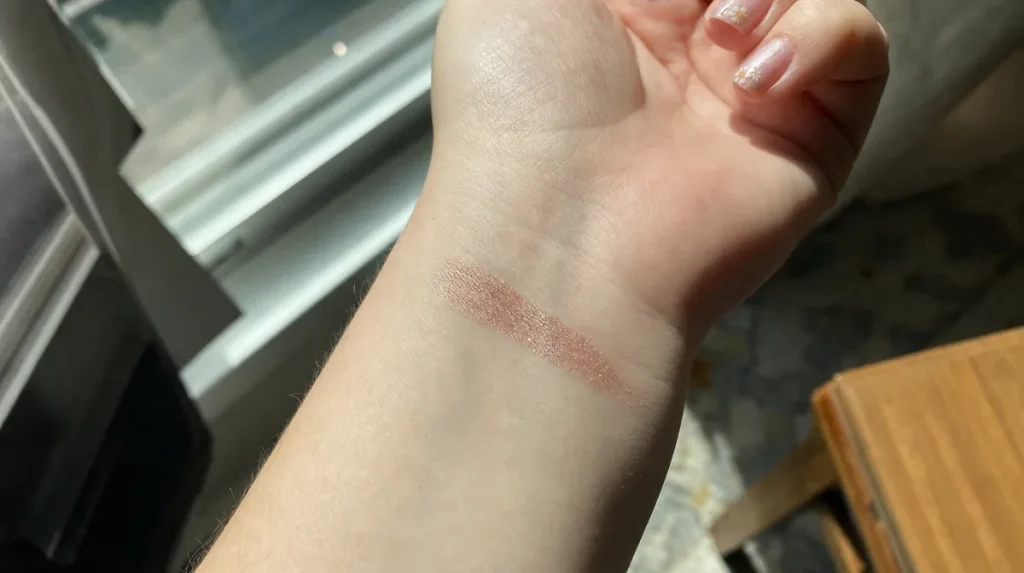
Pigment payoff is the single figure that predicts almost everything else about a palette, and it has nothing to do with the finish printed on the box.
Think of a shadow pan like a roux: the ratio of flour to fat decides whether a sauce thickens in one stir or needs endless whisking. In a pressed shadow, pigment is the flour and binder is the fat. A well-milled, well-loaded pan releases colour with one light pass of a finger or brush. A thin, over-filled pan needs three or four passes and still looks patchy, because there simply is not enough colour per gram of powder.
The self-test takes ten seconds in any shop that allows testers. Swipe a finger once, lightly, no pressing. If the colour shows up true and solid, that is a well-made shadow. If you need to dig in and rub, the formula is under-pigmented and no amount of technique at home will fix it.
Matte shades are the hardest to judge this way because they carry no shimmer to distract the eye, so judge mattes first if a palette has both finishes.
Finding Your Undertone In Daylight

Shop lighting is designed to flatter, which means it is designed to lie a little. Warm, high-CRI bulbs above a beauty counter make cool-toned shadows look neutral and neutral shadows look warm, so a colour that seemed perfect under those lights can read oddly ashy or orange once you step outside.
The fix is simple and free. Swatch the shade, then walk to a window or, better, step outside for a moment. Daylight is the only consistent reference point, because it does not shift between shops or across seasons the way indoor lighting does.
Undertone itself is easier to work out than most counters suggest. Look at the veins on the inside of your wrist in daylight: a greenish cast usually points to a warm undertone, a bluish cast to a cool one, and genuinely not being able to tell either way usually means a neutral undertone, which is the most forgiving to shop for.
A short, unreliable British summer means daylight testing is not always available on demand, so a torch on the phone, held at arm’s length rather than close to the face, is a reasonable stand-in when a window is out of reach.
Why Some Shadows Crease By Lunchtime
Creasing gets blamed on the palette more often than it deserves. In most cases the shadow is only half the story.
Eyelid skin produces more oil than almost anywhere else on the face, and it moves constantly with blinking, which means any product sitting on it is under more mechanical and chemical stress than foundation ever is. A shadow with a high wax or oil content in its own binder will struggle against that environment regardless of how it swatched in the shop.
The practical answer, confirmed in the routines most make-up artists teach, is a thin layer of eye primer or even a light dusting of translucent powder on the lid before shadow goes on. This is not marketing filler. It genuinely changes the surface the shadow has to grip.
A useful diagnostic: if a shadow creases within an hour even over primer, the pigment-to-binder ratio is likely too oily for daily wear in a warm office or under central heating, which dries the surrounding skin but does not stop the lid itself producing oil. If it only creases after six or seven hours, that is closer to normal wear and not a flaw worth returning the palette over.
Testing Blendability Without Buying Anything
Blendability is often confused with softness, but the two are not the same thing. A shadow can feel powder-soft in the pan and still drag or streak once a brush tries to move it across the lid.
A fair test uses the back of the hand again, but this time with two colours side by side rather than one. Swatch a light shade and a darker shade touching at the edges, then use a clean finger to blend the line between them in small circular motions. A well-formulated shadow softens that seam within four or five strokes. A poorly milled one either smears the colours into mud or barely moves at all, sitting stubbornly where it was placed.
The household comparison worth keeping in mind is icing sugar versus caster sugar. Icing sugar, milled fine, dissolves and blends into batter almost instantly. Caster sugar, coarser, needs far more mixing and still leaves texture behind. Eyeshadow pigment works the same way: finer milling blends faster and needs less pressure from the brush, which also means less fallout under the eyes by the end of the process.
What Long-wear Formulas Actually Change
“Long-wear” on packaging usually refers to one of two things: a higher wax content that resists oil for longer, or a fixing spray or primer sold alongside the palette that does the real work. Reading the ingredients list, where the shop allows it, tells you which one you are paying for.
A 2021 study in the International Journal of Cosmetic Science measuring pressed powder eyeshadow wear over an eight-hour period found that formulas with silicone-based binders showed visibly less transfer and fading than talc-heavy formulas tested under the same conditions, though individual skin oiliness still accounted for a meaningful share of the difference between wearers.
That detail matters because it means no single formula performs identically on every face. A shadow that lasts all day on a dry-skinned friend may need topping up by mid-afternoon on oilier skin, and that is not a fault of either the product or the person, simply a mismatch worth planning around with a touch-up brush kept in a bag rather than assumed away.
Where The Marketing Outpaces The Chemistry
Terms like “buildable”, “velvet finish” and “24-hour wear” are not regulated the way active ingredient claims are, so they describe an intention rather than a guaranteed result. None of them are lies exactly, but none of them are measurements either.
What is measurable, and worth looking for instead, is texture description in the ingredient list itself: mica and talc as a base, dimethicone or similar silicones for slip and wear, and boron nitride, when listed, generally signals a softer, more blendable finish. These are not marketing words. They are the actual materials doing the work, and their order on the list roughly reflects how much of each is present.
Good Housekeeping’s Institute testing pages, among others, note that finish claims are best treated as a starting point for judgement rather than a verdict in themselves, which lines up with what any chemist counter assistant will tell you if asked directly rather than shown a display card.
Judging A Palette’s True Versatility Before You Buy
A palette earns its price not by having sixteen shades but by having enough contrast and enough neutral shades to build a full look without reaching for anything else. Counting shades is less useful than counting roles.
A workable palette generally needs four things: a matte shade close to your natural lid colour to use as a base, a slightly deeper matte for the crease, a shimmer or satin for the lid itself, and one genuinely dark shade for definition at the lash line. If a palette is missing one of those roles entirely, no amount of extra shimmer shades compensates for it in practice.
A quick self-test in the shop: try to imagine building one complete, wearable look using only four shades from the palette, without borrowing anything else. If you cannot picture it easily, the palette is likely to sit half-used at home, which is exactly the drawer scenario most people are trying to avoid when they buy in the first place.
When To Walk Away: Reading The Warning Signs
A few signs at the counter are worth trusting more than star ratings online. Chalkiness on first swatch rarely improves with a primer underneath, because the issue is milling, not moisture. Strong fragrance in a shadow, unusual for the category, can suggest masking of a cheaper base, though this is a softer signal and not a rule.
Cracked or crumbly pans, even in an unopened palette, point to a formula that was pressed with too little binder, and it will likely shed fallout under the eyes throughout the day. Held up to daylight, a pan with visible speckling or an uneven surface has usually been milled unevenly, and colour payoff will vary patch by patch.
None of these checks require special tools or expert training, only patience and a willingness to test properly before paying, whether that purchase happens at a chemist counter, a beauty hall, or online where swatches from other buyers stand in for the real thing.
Key Takeaways
A palette worth keeping earns that place through a handful of physical properties, not through the language on its box.
Test pigment payoff with one light swipe, check undertone in daylight rather than shop lighting, and remember that most creasing starts at the base, not in the pan. Long-wear claims usually describe a silicone binder or a paired primer, and versatility is best judged by counting roles a palette can fill, not the number of shades it holds.
Built this way, the drawer of half-used products tends to shrink rather than grow.
A Quick Checklist For The Counter
- Swatch once, lightly, and judge colour by the first stroke, not the third.
- Check the swatch again near a window or in daylight before deciding.
- Blend two shades together on the back of your hand to judge how quickly the seam softens.
- Look for silicone or boron nitride in the ingredient list if long wear matters to you.
- Count the roles a palette fills (base, crease, lid, liner) rather than the number of shades.
- Inspect the pan itself for cracking or uneven speckling before paying.
This article is for general information only and does not replace advice from a qualified professional.
Individual results vary depending on skin type and application.