


Rajesh Kumar, Senior Health and Science Editor.
You are standing in front of the mirror with a straightener in one hand and a fringe that will not sit flat, wondering why the one you bought last winter already feels tired. There is a drawer somewhere in the house with two or three others in it, each abandoned for the same vague reason: it stopped working the way it used to, or it never quite did what the box promised. The question most people type into a search bar is some version of “which hair straightener is actually good”, and the honest answer is that the number printed on the packaging tells you almost nothing. A 2019 study in the Journal of Cosmetic Science measured the surface temperature across straightening plates during use and found some models varied by more than 40 degrees Celsius from one end of the plate to the other, even while the digital display held steady at 200°C. That single fact changes what you should be looking for. This guide walks through what specialists actually check first, in plain terms, so you can judge a straightener on the shelf at a chemist rather than on the strength of the box art.
- The temperature display means less than the temperature consistency: a steady number on the dial says nothing about hot spots along the plate.
- Plate movement matters as much as plate material: how the plates float and close along their full length affects even styling more than the word “ceramic” does.
- Damage shows up over weeks, not on day one: judging a straightener by the first result is the most common mistake buyers make.
Why The Number On The Box Tells You So Little
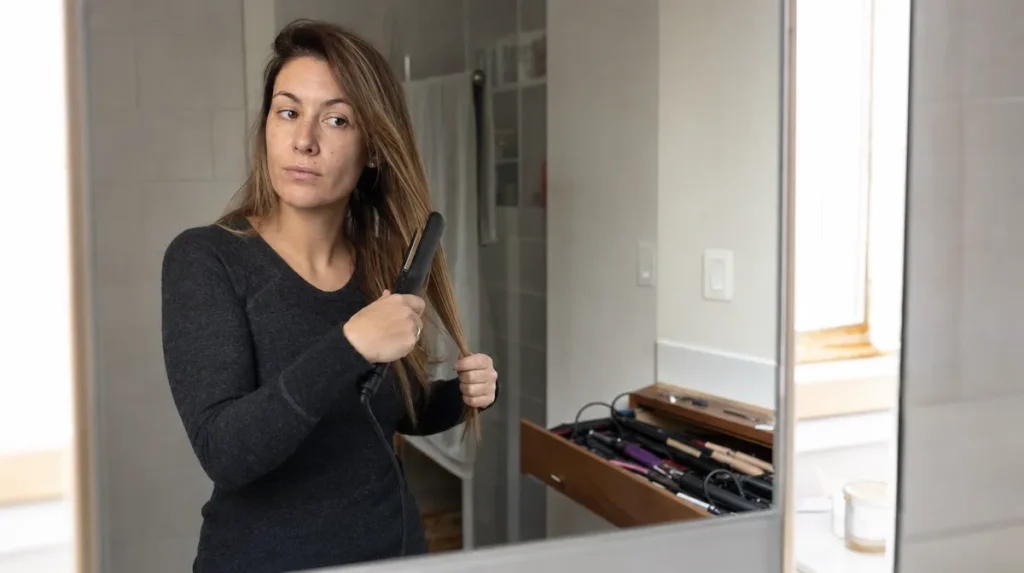
Every straightener sold now carries a maximum temperature figure, usually somewhere between 150°C and 230°C, printed in large type as if it were the whole story. It is closer to the oven dial on a cooker that shows 180°C while the back of the oven runs considerably hotter than the front: you would not judge a cake tin’s position by the dial alone, and the same logic applies here.
The figure on a straightener’s display measures the temperature at one sensor point, usually near the plate’s centre. It says nothing about how evenly that heat spreads to the edges or the tips of the plate, which is where most breakage actually happens. A straightener that runs cooler but consistently across its whole surface will treat hair more gently than one that hits a higher peak with wide swings either side of it.
What specialists look at first, before anything else, is whether a brand publishes any information about temperature stability during continuous use, not just the maximum figure at switch-on. Few do, which is itself telling. Good Housekeeping Institute’s testing engineers have long used repeated-pass measurements for exactly this reason, checking how a tool performs after ten minutes of styling rather than in the first thirty seconds.
If you take one thing from the spec sheet, take this: a lower maximum with a tight, published tolerance is usually a better sign than a high maximum with no mention of consistency at all.
How The Plates Actually Move Across Your Hair
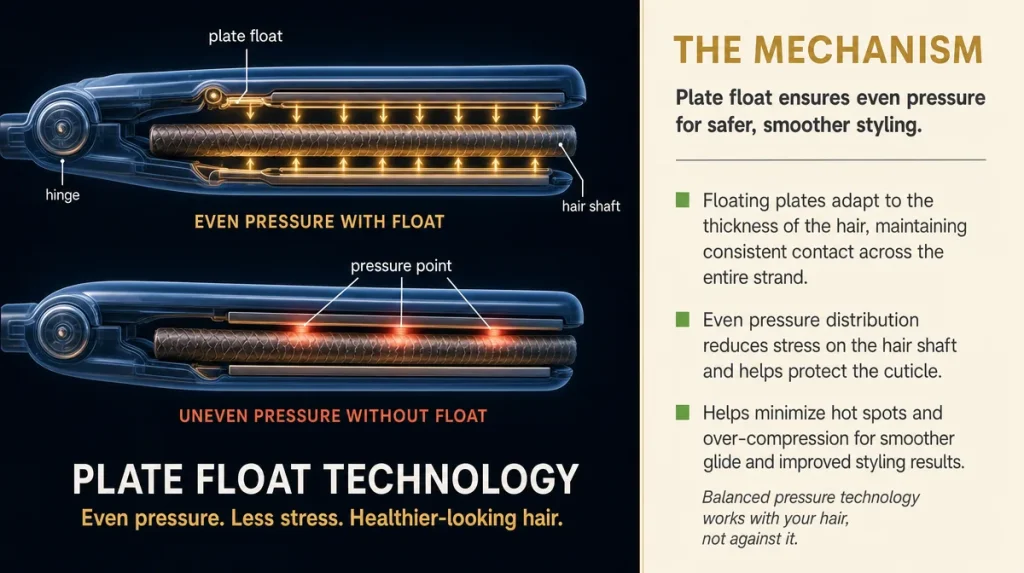
Most straighteners look like two flat surfaces on a hinge, but the useful ones have a small amount of give built into that hinge, often called plate float. It allows the plates to adjust slightly as they pass over sections of hair that are thicker or thinner, keeping even pressure along the whole length rather than just at the tips where most people naturally squeeze.
Think of a rolling pin with a slight wobble in the handle, pressing biscuit dough of uneven thickness. Without any give, the thin patches burn while the thick ones stay raw. Plate float does something similar for hair: it lets the tool respond to the section passing through it instead of applying identical pressure regardless of thickness.
A straightener with rigid, unmoving plates will often feel more powerful in the shop, because the closure feels firm and definite. In practice, that rigidity is what produces the uneven results people complain about later: crisp at the roots, missed at the mid-lengths, frizzy again by the ends.
You can feel for this yourself before buying. Close the plates on a folded tissue and try sliding it through slowly. If one end grips noticeably harder than the other, or if the plates only meet cleanly at the tip and not along the full length, that unevenness will show up in your hair too.
The Word “Ceramic” And What It Does Not Tell You
Almost every straightener sold today calls itself ceramic, tourmaline or ionic somewhere on the packaging, and the words have started to blur into background noise. They are not interchangeable, and none of them guarantees quality on its own.
Ceramic can mean a solid ceramic plate, which retains and distributes heat evenly, or it can mean a thin ceramic coating sprayed over a metal base, which wears away with use and can leave patches of bare metal that heat unevenly and drag on hair. The packaging rarely distinguishes between the two, because the word alone sells.
Tourmaline and ionic claims relate to negative ion generation, which is marketed as reducing frizz by breaking down water molecules on the hair surface more gently. The evidence for this is modest and largely comes from manufacturer testing rather than independent trials, so it is worth treating as a possible bonus rather than a deciding factor.
What actually predicts performance, more reliably than any of these words, is whether the plates feel smooth and glass-like to the touch with no visible texture or seam, and whether the brand is transparent about what the coating is made of rather than relying on the word alone. Which? has tested this repeatedly in its comparative reviews over the years, generally finding that plate smoothness and evenness correlate with user-reported satisfaction far more than the ionic or tourmaline labelling does.
Where Heat Damage Actually Starts, Inside The Strand
Straightening works because hair’s structural protein, keratin, is held together partly by hydrogen bonds that respond to heat and moisture. Applying heat with a small amount of residual moisture temporarily loosens those bonds enough to reshape the hair, and cooling locks the new shape back in. It is the same basic principle as steam-pressing a shirt: heat and moisture soften the fabric’s structure just long enough to reshape it, and it holds once it cools.
Damage happens when that process goes too far. If the plates drive off moisture too quickly or hold heat on the strand for too long, the protein itself can begin to denature rather than simply reshape, and that change is not reversible with conditioner or time. A 2013 paper in the International Journal of Trichology examined hair samples after repeated heat styling and found visible protein breakdown and moisture loss concentrated at points where heat exposure was longest, typically where a user paused or went over a section twice.
This is why speed and a single pass matter more than people expect. Going over the same section three or four times because the first pass did not fully straighten it is usually a sign the temperature is too low for that hair type, not a reason to keep repeating the pass at the same setting. Multiple slow passes concentrate exactly the kind of prolonged heat exposure that the research links to lasting damage.
Reading The Claims: What Matters And What Is Marketing
Straightener packaging tends to lean on a small set of words: salon-grade, infrared, professional, advanced. None of them are regulated terms, so a brand can use them freely without meeting any defined standard.
A more useful set of questions to ask, standing at the shelf, looks like this. Does the display show the actual plate temperature or an estimated setting. Is there a lock function that prevents the temperature drifting while the tool heats up and cools between uses. Does the cord swivel freely, which sounds trivial but affects how much you twist and strain the internal wiring over months of use, a common reason straighteners fail early. Is the heat-up time specified, since a tool that takes eight minutes to reach temperature is one you will be tempted to use before it is properly ready.
The British Beauty Council has published guidance in recent years on heat styling tool safety more broadly, focusing on plate temperature stability and cord integrity as the two features most linked to both performance and safety incidents. None of that guidance names specific products, but the categories it flags line up closely with what specialists check first: consistency, not headline claims.
If a brand’s marketing focuses entirely on a single flashy word rather than any of these practical details, that absence is itself useful information.
A Five-minute Test You Can Do At The Counter
You do not need a laboratory to get a reasonable read on a straightener before buying it, and shop staff at Boots or Superdrug will usually let you handle a display model.
First, close the plates fully and run a finger lightly along the full length, checking that they meet flush from the hinge to the tip rather than gapping in the middle, which is common on cheaper hinges. Second, check the plate surface for any visible seam, rough patch or discolouration, which suggests a worn or thin coating even on a brand-new display unit. Third, test the cord: hold the tool at arm’s length and let the cord hang, then twist it gently. It should swivel freely at the point it meets the handle rather than the whole cord twisting up towards your hand.
Fourth, if the display model is switched on, hold your hand near but not touching the plates and move it slowly from the hinge end to the tip. Any obvious difference in heat intensity along that path is a hint at the uneven distribution the earlier sections describe.
None of this replaces a proper test on your own hair over several weeks, but it filters out the tools most likely to disappoint before you have spent anything at all.
Judging Your Results Honestly, Week By Week
The first use of a new straightener nearly always looks good, because hair that has not been repeatedly heat-styled with that particular tool has not yet shown any cumulative effect. Judging quality from day one is the most common mistake buyers make, and it explains a lot of the disappointment that shows up months later.
A more honest test runs over six to eight weeks. Watch for dryness at the mid-lengths and ends that does not respond to your usual moisturiser or leave-in conditioner. Watch for split ends appearing faster than they did with your previous routine. Watch for hair that takes noticeably longer to hold a style, which can indicate the internal structure is being reshaped less cleanly each time.
Shine is a reasonably reliable, low-effort indicator. Healthy hair reflects light in a continuous line along the strand; damaged hair scatters it, looking duller even directly after styling. If shine drops off within the first fortnight of using a new tool, that is worth paying attention to rather than dismissing as a bad hair day.
Damp British winters make this harder to judge, since central heating already dries hair out independently of any styling tool, so it helps to give a new straightener a fair trial across a stable few weeks rather than the driest week of January.
The Mistakes Nearly Everyone Makes
A short list of habits causes more damage than the tool itself in most cases.
Using the maximum setting regardless of hair type is the most common. Fine or previously coloured hair rarely needs anything close to 220°C, and doing so simply increases the risk of the protein damage described earlier without improving the result.
Straightening hair that is still damp, rather than fully dried first, forces the moisture inside the strand to turn to steam under the plates, which can cause visible bubbling and breakage. Heat protectant sprays help by forming a barrier that slows moisture loss, though their effect is modest rather than complete, so they are a helper, not a licence to raise the temperature.
Sectioning too broadly is another. Taking a section too thick for the plates to close fully around means the outer layers get styled while the inner layers do not, leading to repeated passes over the same hair, which returns to the damage risk covered earlier.
Finally, many people keep a straightener long after the plates have visibly worn, simply because it still gets hot. A worn coating changes how the tool interacts with hair even at the same temperature setting, so a visual check every few months is worth the minute it takes.
Key Takeaways
Judge a straightener on consistency of heat, not the maximum figure on the box. Check how the plates move and close along their full length, not just how firm the closure feels in the shop. Give any new tool a genuine six to eight week trial before deciding it works for your hair, and watch shine and dryness rather than the very first result.
A Quick Checklist Before You Buy
- Ask whether the brand publishes anything about temperature stability, not just the maximum setting
- Run a finger along the closed plates to check they meet flush from hinge to tip
- Look for a smooth, unmarked plate surface with no visible seam or wear
- Check the cord swivels freely at the handle
- Choose a temperature suited to your hair type rather than defaulting to the highest setting
- Judge results over six to eight weeks, watching shine and dryness rather than the first pass
This article is general information and does not replace advice from a qualified professional.
Individual results vary depending on hair type, condition and styling habits.