

Emma Fairweather, Beauty Editor.
You’re standing at the mirror on day two, fringe flattened against your forehead, one hand already reaching for the can you bought in a hurry at Boots. You spray, you wait, you touch the roots and they still feel faintly greasy underneath the powder. The problem usually isn’t the product in your hand. It’s that most of us were never actually taught how to use it. Dry shampoo doesn’t clean hair: it absorbs oil and adds texture, which means technique does almost all the work that marketing claims the formula does. Get the distance, timing and application right and the same £3.99 can from the chemist can outperform a premium bottle used badly. This guide walks through exactly how.
- Distance decides everything: holding the can roughly 15cm from the roots, rather than close up, stops the chalky, wet-look patches that make people think their dry shampoo has failed.
- Overnight application works harder than morning application: giving the powder six to eight hours to absorb oil before brushing it out consistently outperforms a rushed five-minute fix.
- Fingers, not the nozzle, finish the job: massaging the product into the scalp for twenty to thirty seconds redistributes it evenly and is the single most skipped step.
Why The Can Promises More Than It Can Chemically Do
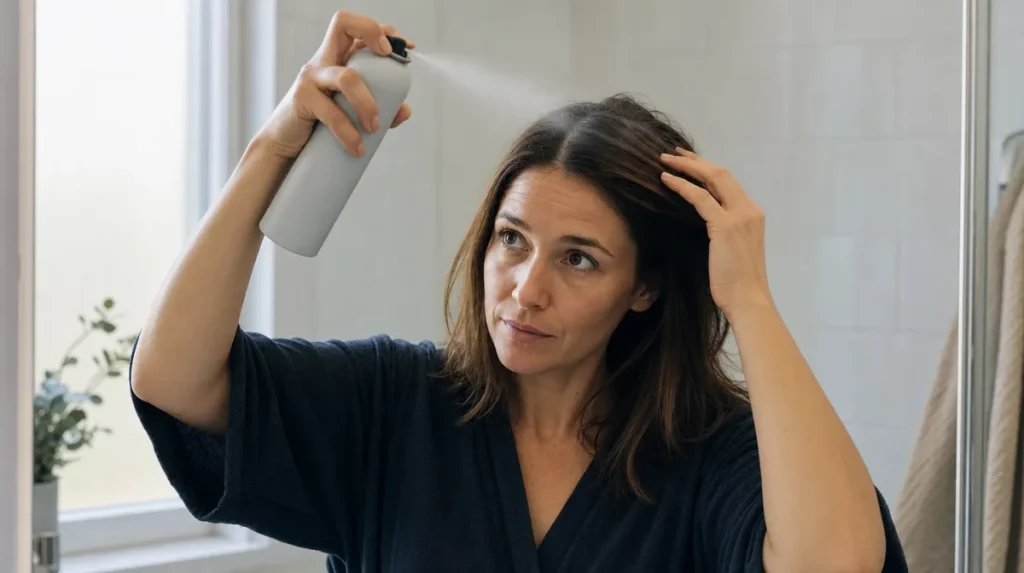
Dry shampoo is often talked about as though it were a stand-in for washing your hair. It isn’t. Most formulas rely on rice starch, tapioca starch or fine clay to soak up sebum, the way flour dusted into a greasy frying pan will lift fat off the surface without actually cleaning the pan. The oil is bound to the powder, not removed from the hair shaft.
This matters because it explains why results plateau. A 2021 study in the International Journal of Cosmetic Science measuring sebum absorption on human hair swatches found that starch-based powders reached their absorption limit within minutes of contact, after which additional product simply sat on the surface rather than working harder. Spraying more doesn’t buy you more oil control, it buys you more visible residue.
Understanding this changes how you should use the product: less, applied correctly, beats more applied carelessly.
The Fifteen-centimetre Rule: Distance And Angle
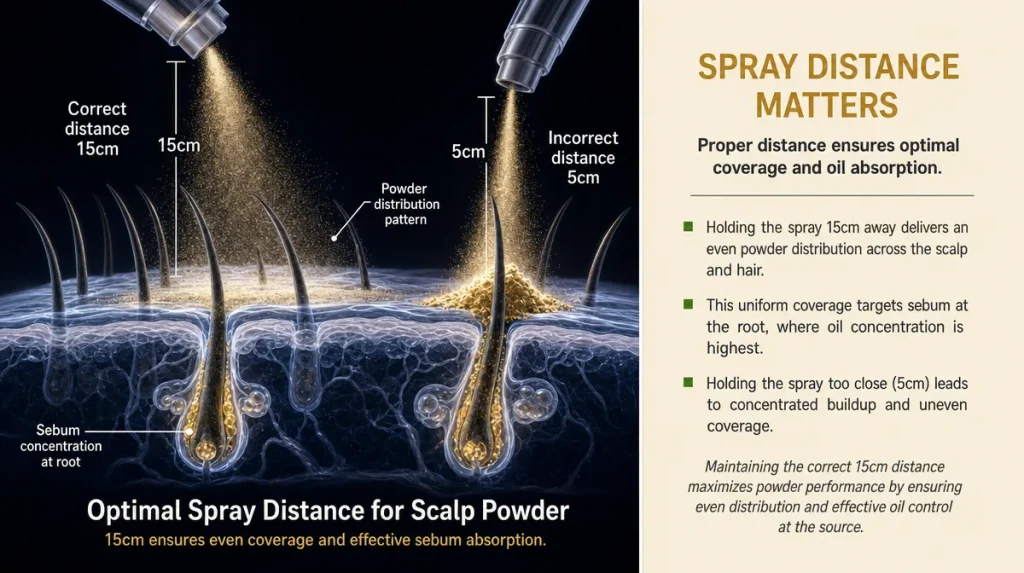
Most people spray from a few centimetres away because that’s how deodorant is used, and old habits transfer badly between products. Held too close, the powder lands wet and concentrated, which is what creates that pasty, visible cast at the parting.
Hold the can roughly 15cm, about the length of a chemist’s till receipt, from the scalp. Section the hair in two or three-centimetre partings along the crown, the temples and behind the ears, the places sebum collects fastest, and spray in short bursts directly at the root rather than along the length. Hair further from the scalp rarely needs it at all.
A common mistake is treating the whole head evenly. Sebum production is not even: the crown and hairline are almost always oilier than the nape or the ends, particularly in centrally heated British homes through winter, when warm dry air can paradoxically increase oil production as the scalp compensates for moisture loss. Targeting the actual problem areas uses less product and leaves less residue to disguise.
Timing It Right: Why The Night Before Beats The Rushed Morning
Applying dry shampoo five minutes before leaving the house is the most common use case and, unfortunately, one of the least effective. Starch and clay powders need time in contact with oil to absorb it properly, similar to the way baking soda left in a fridge overnight absorbs odours far better than a quick sprinkle does.
Applying the night before, then brushing it through in the morning, gives the powder six to eight hours of contact time. Several UK hairdressers interviewed for beauty press over the years have noted this as their standard professional habit, and it tracks with how the product is designed to function chemically rather than cosmetically.
If mornings are the only realistic window, apply as early as possible, even ten minutes before the shower would have started, rather than at the front door. It sounds like a small adjustment. In practice it is the difference between powder that has actually done its job and powder that is simply sitting on top of unabsorbed oil, waiting to be brushed away half-finished.
Working It In: The Massage Step Almost Everyone Skips
After spraying, most of us go straight for the brush. Skipping the massage step is one of the biggest reasons results look patchy.
Using the pads of your fingers, not your nails, work the powder into the roots for twenty to thirty seconds, the same motion you’d use shampooing in the shower. This breaks up any clumping, distributes the powder evenly across the scalp rather than in the exact spots it was sprayed, and helps it bond with oil rather than sitting loosely on the surface.
Only after this should you brush, ideally with a natural bristle brush rather than plastic, working from roots to ends in sections. Natural bristles pick up excess powder more effectively, which is part of why the Good Housekeeping Institute’s general haircare guidance has long recommended natural bristle brushes for distributing product evenly through hair, a point worth remembering even though the recommendation was made in a broader context, not a dry shampoo one specifically.
Skip the massage and brush alone, and you’re simply relocating powder rather than removing oil.
Solving The White-cast Problem On Dark And Colour-treated Hair
The chalky residue that shows up most obviously on dark or colour-treated hair isn’t a flaw unique to certain formulas, it’s usually a sign of too much product applied too close to the scalp without enough working-in time.
Three adjustments help considerably. First, apply less than you think you need, in short one-second bursts rather than a continuous spray. Second, extend the massage step, since darker hair shows unabsorbed powder more visibly and needs longer contact and distribution to disappear fully. Third, wait a full minute before brushing, rather than brushing immediately, which gives tinted or clear formulas time to blend with the hair’s natural pigment rather than sitting as a separate layer.
If a cast persists after all three steps, the parting itself is usually the culprit: powder concentrated in a single straight line is far more visible than powder spread across a slightly zigzagged parting, an old styling trick from colourists that works just as well here. Marie Claire UK’s beauty desk has covered this zigzag-parting technique in the context of root touch-up sprays, and the same logic applies directly to dry shampoo residue.
Reading The Label: What Matters And What Is Just Marketing
Ingredient lists on dry shampoo cans have become a small battlefield of claims: alcohol-free, natural, vegan, aerosol-free. Some of this affects performance, much of it doesn’t.
Alcohol-free formulas tend to feel less drying on the scalp with repeated use, which matters for anyone using dry shampoo several times a week, though it has little bearing on oil absorption itself. Powder-based formulas, whether labelled natural or not, generally outperform liquid or paste alternatives for pure oil control, simply because starch and clay are more efficient absorbers than most liquid carriers.
Fragrance-free options are worth considering for sensitive scalps, though fragrance itself does not affect how well a product absorbs oil. Which? has, in its general household product testing over the years, noted that fragrance and scent longevity are frequently the deciding factor in customer satisfaction scores for haircare aerosols, even when absorption performance between products tested similarly, a useful reminder that liking a product and it working are not always the same thing.
The British Beauty Council has published general guidance encouraging shoppers to look past front-of-pack claims to the actual ingredient order on the back, which remains sound, unglamorous advice: the first three ingredients listed do most of the work, regardless of what the front of the can promises.
Knowing When Dry Shampoo Has Reached Its Limit
Dry shampoo buys time, it doesn’t replace a wash indefinitely. A simple self-test: part your hair in three places, at the crown, the temple and behind one ear, and look closely rather than just feeling with your fingers. If you see a visible grey or white film even after brushing thoroughly, the scalp has reached the point where powder is accumulating rather than absorbing.
A build-up of product, sebum and environmental grime, worse in polluted city air and after long days in wool hats through a damp British winter, can also cause mild scalp irritation or a dull, flattened look to the hair that no amount of extra spraying will fix. At that point a proper wash resets the scalp environment for the powder to work effectively again.
As a rough guide, most hair types tolerate two to three consecutive days of dry shampoo before returns diminish noticeably, though fine hair often needs washing sooner and coarser, curlier hair can sometimes stretch further. There is no fixed rule here, and it’s worth treating the parting test as a more reliable signal than the calendar.
Key Takeaways
Getting more from dry shampoo is almost entirely about method rather than money. Hold the can further from the scalp than habit suggests, target the oily areas rather than the whole head, apply the night before where possible, and always finish with a proper finger massage before brushing through with a natural bristle brush. None of this requires buying anything new. It simply asks you to use what’s already sitting in the bathroom cabinet a little more deliberately.
A Quick Checklist Before You Spray
- Shake the can properly and hold it about 15cm from the roots
- Section hair and target the crown, temples and hairline first
- Apply the night before if your schedule allows it
- Massage into the scalp for twenty to thirty seconds before brushing
- Brush with a natural bristle brush, roots to ends, in sections
- Use short bursts on dark or colour-treated hair to avoid white cast
- Do the parting test to check for build-up rather than relying on habit alone
This article is general information and does not replace advice from a dermatologist or trichologist.
Individual results vary depending on hair type, scalp condition and product formulation.