


Emma Fairweather, Beauty Editor.
There is a particular kind of disappointment that arrives around midday. You catch your reflection in a shop window on the way to lunch and the colour you applied at half past seven has thinned to a stain in the centre of your lips, vanished from the rim of your coffee cup, and left a faint ring on your collar. Most people who wear lipstick regularly own a make-up bag half full of tubes bought on the promise of all-day wear that didn’t survive a single school run.
The reason is less mysterious than the packaging suggests. Long-wear lipstick works, when it works, because of one specific bit of chemistry: a film-forming polymer that dries to a thin, flexible coat on the lip, rather than a wax-and-oil blend that simply sits there and rubs off. Once you understand that single mechanism, you can judge almost any long-wear claim yourself, without a chemistry degree or a favourite brand to defend. This guide sets out what actually keeps colour on your lips, what is marketing language dressed up as science, and how to test a lipstick properly before you commit to it.
- Film-forming polymers, not wax, do the real work: a long-wear lipstick dries to a thin plastic-like coat that resists friction, which is a different job to the soft, glide-on feel of a traditional bullet.
- Preparation and application account for more of your wear time than the formula does: chapped, unexfoliated lips and heavy first coats fail faster than a mediocre lipstick applied properly.
- Longer wear and lasting comfort pull in opposite directions: the most transfer-resistant formulas tend to be the most drying, so the honest question is which trade-off suits your lips, not which tube claims the highest number of hours.
Why Lipstick Actually Fades
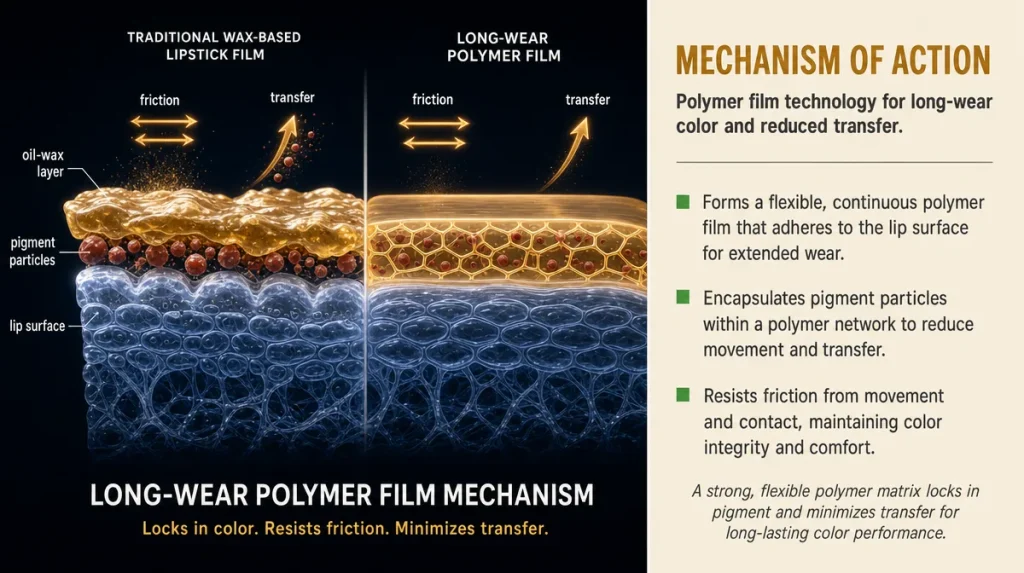
Traditional lipstick is built from waxes and oils that suspend pigment in a soft, glossy film. It feels lovely going on because it is, chemically speaking, still half-liquid on your lips. That softness is also why it moves: onto a wine glass, a napkin, the collar of a white shirt.
Long-wear formulas swap much of that wax base for film-forming polymers, ingredients that dry down into a thin, semi-rigid coat, closer in behaviour to a coat of nail varnish than to a balm. A 2019 formulation study in the International Journal of Cosmetic Science described how polymers such as trimethylsiloxysilicate form a flexible, low-tack film that resists transfer far better than an oil-based matrix, at the cost of some slip and comfort.
Think of it as the difference between painting a wall with an oil-based gloss, which stays tacky for hours and picks up fingerprints, and a modern quick-dry paint that sets to a hard, wipeable finish within minutes. Both are paint. They behave completely differently once dry.
Understanding this is useful because it reframes the question. A long-wear lipstick is not simply a better version of an ordinary one. It is a different type of product, with different strengths, and it is worth choosing on those terms rather than on the number printed on the box.
Finding Your Undertone In Daylight
Shop lighting is designed to flatter merchandise, not skin, and fluorescent tubes in particular tend to wash colour towards yellow or pink depending on the fitting. A lipstick that looks perfect under a beauty counter’s lights can look markedly different on the bus home.
The simplest fix is to test in daylight, ideally near a window, before you decide. Swatch the colour on the back of your hand or, better, along your jaw, where the tone is closer to your lips. Bullet colour and swatched colour are often surprisingly different once pigment meets skin oils.
A quick self-test: look at the veins on the inside of your wrist in natural light. Green-leaning veins usually indicate a warmer undertone, blue-leaning veins a cooler one, and if you genuinely cannot decide, you likely sit somewhere neutral. This is not a precise science, but it is a reasonable starting point before you spend money on a colour that reads muddy against your own skin.
The most common mistake is choosing a lipstick because it looked striking in a photograph or on someone else entirely. Skin tone, lip pigmentation and even the season change how a shade reads. A colour that looked warm and rich in July can look slightly grey against paler winter skin.
Reading The Label Without A Chemistry Degree
Ingredient lists on lipstick are ordered by concentration, highest first, much like a food label. The first four or five entries tell you what you are mostly buying: an oil or emollient base, a wax or polymer, and a solvent. Pigments, usually listed as CI followed by a number, tend to sit further down the list even in a strongly coloured lipstick, because pigment is potent in small amounts.
Words like “long-wear complex” or “colour-lock technology” are marketing names for a blend the brand has chosen not to fully explain, which is fair enough commercially but tells you nothing you can independently verify. What is worth looking for instead is any mention of film-forming agents, silicone derivatives ending in -siloxane, or specific polymers, since these are the ingredients doing the actual work described earlier.
The Good Housekeeping Institute’s published testing guidance notes that wear claims are typically assessed across a full day including meals, rather than in a single sitting, which is a useful benchmark to hold any product against. Which? has likewise offered general consumer advice on treating on-pack longevity claims with some scepticism until you have tried a product yourself, since laboratory wear tests and a normal day of eating, drinking and talking rarely match exactly.
Dermatologist-tested, incidentally, means a dermatologist supervised a safety patch test, not that the product outperforms others for wear or comfort.
The Lip Prep Step Everyone Skips
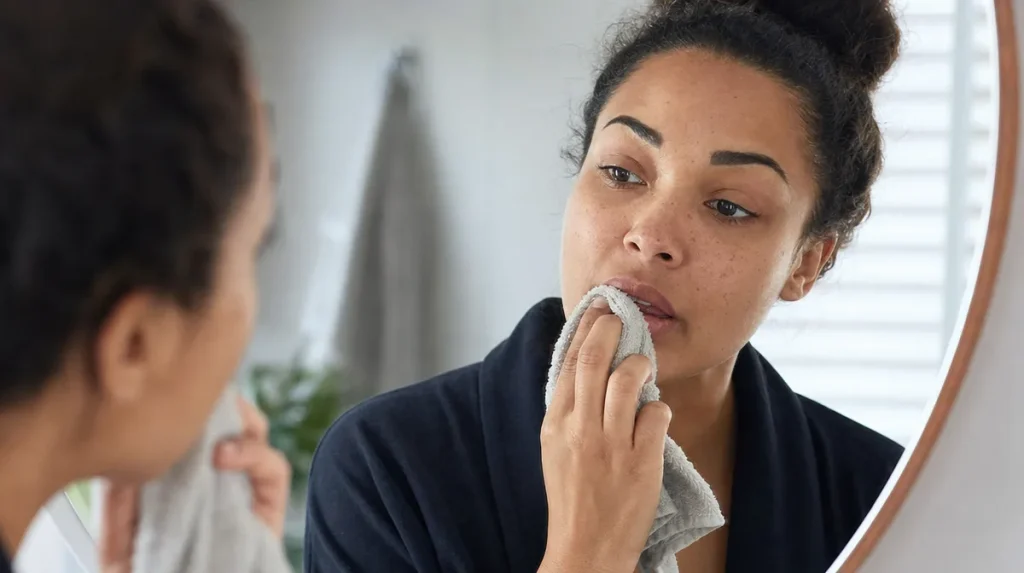
Lips have no oil glands of their own, which is why they dry out faster than the rest of the face, particularly through a damp British winter when central heating pulls moisture from indoor air more aggressively than the cold outside does. Applying any lipstick, long-wear or otherwise, over flaking or chapped skin gives the formula an uneven surface to grip, and it will crack and thin exactly where the skin is roughest.
A gentle exfoliation, using a damp flannel in small circles or a proper lip scrub once or twice a week, removes the loose, dry cells that would otherwise flake off mid-morning and take colour with them. Follow with a balm and give it a few minutes to absorb before applying lipstick, rather than layering colour straight over a greasy film, which stops a polymer-based formula from bonding properly to the skin.
It is the same logic as painting a wall: sand it first, or the paint will crack along every ridge and crumb of old plaster. Skip the prep and even the best-formulated lipstick is fighting a losing battle against the surface underneath it.
This single step, more than any specific product, is the difference most people notice between a lipstick that “never lasts” and the same lipstick applied on a well-prepared lip.
The Application Method That Adds Real Hours
Most fading happens fastest in the first hour, as the film is still settling, so how you apply matters as much as what you apply. Lining the lips first with a matching pencil, then filling in with lipstick, gives the polymer film an edge to grip rather than sitting loosely on bare skin, which is one reason lined lips tend to hold their shape longer through the day.
A thin first coat, pressed with a single-ply tissue, then a second thin coat, generally outlasts one thick coat. The blotted layer sets into the polymer film beneath it rather than sitting as a separate, soft top layer that transfers onto the first thing it touches.
A useful self-test: apply as usual, press a tissue flat against your lips once, and look at how much colour transfers. Heavy transfer at this stage usually means either too much product or a formula still drying down, and either way you will likely see fading on the first coffee cup of the day.
The common mistake is topping up throughout the day without removing what remains first. Reapplying over tired, patchy colour tends to look worse and wear less evenly than removing the residue and starting the thin-coat method again.
What “Transfer-proof” Really Costs You
The highest-performing long-wear formulas, the ones that survive a full meal with barely a mark on the cutlery, generally achieve that by minimising the emollient content that would otherwise make the film soft and mobile. Less emollient means less movement, and also, often, less comfort.
This is the trade-off worth understanding before you chase the highest number on a box. A formula built for maximum transfer resistance may feel tight or slightly stiff after a few hours, and on lips that are already dry, particularly through a British winter, it can emphasise flaking rather than disguise it.
Manufacturers have narrowed this gap over the past decade with two-step systems, a colour layer followed by a balm top coat, which aim to keep the polymer benefits while restoring some comfort. Even so, no formula fully escapes the underlying chemistry: more film, less flex, and vice versa.
The practical takeaway is to treat transfer-proof claims as one dial among several, not the only measure of quality. A lipstick that lasts eleven hours but leaves your lips visibly dry and uncomfortable by hour four has not actually solved your problem, whatever the label says.
Judging Results Properly: How Long Is Long Enough
Brands often test wear time under conditions that do not resemble an ordinary day: no eating, no drinking, minimal talking, sometimes measured against a fabric rub rather than real contact with skin or cutlery. A figure of twelve or sixteen hours from a laboratory sheet may translate to four or five hours of genuinely intact colour once lunch, a cup of tea and normal conversation are factored in, and that gap is not a flaw in your technique.
A fairer way to judge a lipstick is to test it yourself across one ordinary day: apply as you normally would, note the time, and check colour after your next hot drink, after lunch, and again by early evening. Most well-formulated long-wear lipsticks should show visible colour at the edges and some pigment remaining in the centre of the lips by the mid-afternoon, even if a full reapplication is needed by then.
Uneven fading, where colour disappears from the centre of the lower lip first, usually points to friction from eating and drinking rather than a poor formula, and is normal even with strong long-wear products. Even, all-over fading by lunchtime is a better sign that the formula itself, or the prep beneath it, is the issue.
Expecting a single application to survive an entire day of meals untouched is, for almost any formula on the market, an unrealistic bar. Results vary by lip texture, diet and climate, and a formula that performs well for one person may behave differently for another.
What Is Marketing And What Actually Matters
Certain phrases on lipstick packaging describe a genuine mechanism. Others describe a feeling the brand would like you to associate with the product. Learning to tell the two apart takes the guesswork out of shopping.
Phrases worth taking seriously include any specific mention of a film-forming polymer, a stated wear-testing method, or a disclosed pigment concentration, because these point to something measurable. Phrases that sound impressive but describe very little include “second-skin technology”, “kiss-proof” and “weightless colour”, which are sensory descriptions rather than claims that can be independently checked.
“Clinically tested” is another phrase worth reading carefully. It generally means a test was conducted, not that the product outperformed competitors, and it rarely specifies sample size or duration. A specific figure, such as a stated number of participants or hours, is more informative than the word “clinically” on its own.
The most reliable signal, in the end, is not any single word on the box but whether a brand is willing to explain, even briefly, how it tested the claim it is making. Vague confidence is cheap to print. Specific, checkable detail is not.
Key Takeaways
- Long-wear lipstick relies on film-forming polymers, not wax, which is why it behaves and feels differently to an ordinary bullet.
- Preparation, exfoliation, hydration, a thin first coat, blotting, matters more to total wear time than most people assume.
- Maximum transfer resistance and maximum comfort generally sit at opposite ends of the same dial, so choose the trade-off that suits your lips rather than the highest number on the box.
- Laboratory wear-time claims rarely match a real day of eating, drinking and talking, so test any lipstick against your own ordinary day before judging it.
- Marketing phrases that describe a feeling are not the same as claims you can check. Look for specifics, not adjectives.
A Quick Checklist Before You Buy
- Swatch the colour in daylight, not shop lighting, ideally near a window.
- Check the first five ingredients for a film-forming or polymer ingredient rather than relying on the front-of-pack name.
- Exfoliate and moisturise lips beforehand, especially in winter months when heating dries skin further.
- Apply a thin first coat, blot with tissue, then a thin second coat.
- Test wear across one full ordinary day, including a hot drink and a meal, before deciding whether the formula suits you.
- Treat any number above roughly six to eight hours of real-world wear with mild scepticism unless the brand explains how it was measured.
This article is general information and does not replace personalised advice from a dermatologist or pharmacist.
Individual results vary by lip condition, diet and climate, so treat wear-time figures as a guide rather than a guarantee.