
Rajesh Kumar, Senior Health and Science Editor.
Stand in front of the bathroom mirror holding two hairdryers you bought at different times, for different reasons, and ask yourself honestly which one actually does a better job. Most people cannot answer. They remember the price, perhaps the colour, maybe that the box mentioned something about ions. What they rarely remember is why they chose it.
That gap matters, because a hairdryer is one of the few beauty tools used almost daily for years, and the wrong one can leave hair visibly frizzier, duller or more prone to breakage over time. A specialist assessing a hairdryer does not start with wattage or price. She starts with airflow, heat control and how the two work together on wet hair. This guide walks through that same thinking, in plain terms, so you can judge any hairdryer on a Boots or Superdrug shelf without needing a single spec sheet translated for you.
One fact worth holding onto early: the speed of the airflow, not the temperature, does most of the work of drying hair. Heat alone, applied for too long, is what causes the damage people blame on “cheap” dryers.
- Wattage is a poor proxy for performance: a higher number on the box does not reliably mean faster or gentler drying, and some lower-wattage motors outperform louder, pricier ones.
- Airflow speed does more of the actual drying than heat does, which is why professional-style dryers lean on strong, directed air rather than maximum temperature.
- The attachments you already own, used correctly, often matter more than any badge on the box, including concentrator nozzles and diffusers most people never bother to fit.
Why The Wattage Number On The Box Misleads You
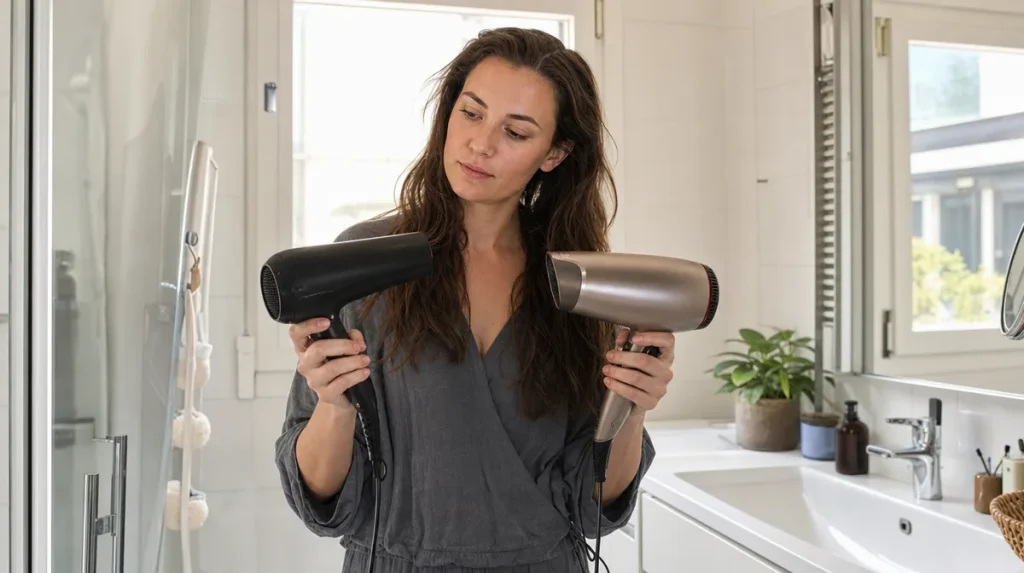
Wattage measures how much electrical power a motor can draw, not how well it moves air or how gently it treats hair. It is a bit like judging a kettle by its wattage alone: a 3000W kettle boils water faster than a 2200W one, but it tells you nothing about whether the water tastes right once it is poured.
A hairdryer’s motor converts electricity into moving air, and the design of the internal fan, the nozzle shape and the heating element all affect how that air reaches your hair. Two dryers rated at the same wattage can feel completely different in use: one pushes a narrow, forceful stream, the other a wider, gentler one.
The mistake most buyers make is comparing wattage the way they might compare a vacuum cleaner, assuming more power simply means more effective. In practice, airflow speed, usually measured in litres per minute by manufacturers who bother to publish it, correlates far more closely with drying time than wattage does.
A simple self-test in the shop: hold your palm about 15 centimetres from the nozzle on the highest airflow setting, not the highest heat. If you can feel a strong, steady push of air rather than a weak puff with lots of warmth, that is usually the better engineered motor.
How A Hairdryer Actually Dries Hair
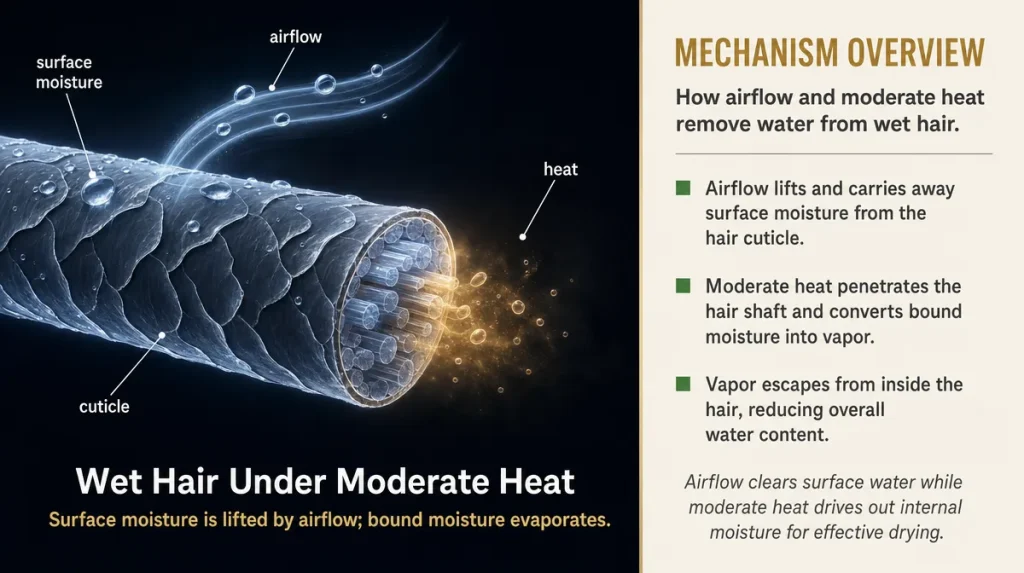
Wet hair holds water in two places: on the surface, as a visible film, and bound more loosely within the hair shaft itself. Airflow does most of the work of removing surface water, in the same way wind dries a line of washing faster than the sun alone on a still day. Heat helps evaporate the remaining, more stubborn moisture, but it is a secondary tool, not the main one.
This is why professional stylists often dry on a cooler setting with the airflow turned up, moving the dryer constantly rather than holding it still on one section. Constant movement spreads the heat exposure across more hair for less time per strand, reducing the cumulative heat damage.
A 2011 study published in the Journal of Cosmetic Science, examining heat exposure on hair fibres, found that intermittent drying at lower sustained temperatures produced less surface damage to the cuticle than continuous high-heat exposure over the same total drying time. The practical takeaway is simple: a dryer that lets you use strong airflow at a moderate, stable heat will usually treat your hair more kindly than one that only feels effective on its hottest setting.
Matching Airflow To Your Hair’s Actual Thickness
Fine hair and thick, coarse hair do not need the same dryer, though most people buy whichever one is on offer that week. Fine hair dries quickly and is more easily over-processed by sustained heat, so it benefits from strong airflow at a lower heat setting. Thick or coarse hair holds more water and can tolerate, and often needs, a higher heat setting used for longer, but still with good airflow to avoid simply baking the outer layers while the inside stays damp.
A quick self-test: take a single dry strand and roll it between your fingers. If it feels smooth and almost slippery, you likely have fine to medium hair. If you can feel texture, ridges or a slight roughness, your hair is probably coarser and can handle more heat without the same risk of damage.
The mistake people with fine hair make most often is buying a dryer marketed for salon-level heat, then using the highest setting out of habit, when a lower heat and higher airflow setting would dry just as quickly with less frizz afterwards. Those with thick hair make the opposite mistake, giving up on a weak dryer too early and leaving hair half-dry, which then air-dries unevenly and loses shape.
What Ionic And Ceramic Claims Actually Mean
“Ionic” technology refers to a small internal component that generates negatively charged ions, intended to break up water droplets on the hair surface into finer particles that evaporate faster, while also, according to the manufacturers who popularised the claim, reducing static and smoothing the cuticle. The evidence for the static-reduction effect is reasonably consistent in small trials; the evidence for dramatically improved shine is thinner and relies mostly on manufacturer-funded testing rather than independent peer review.
“Ceramic” or “tourmaline” coatings on the heating element are designed to distribute heat more evenly across the airflow, avoiding the hot spots that can occur with a basic metal coil. This matters more than it sounds: an uneven heat source can scorch one section of hair while leaving another still damp, which is part of why some older or very cheap dryers seem to damage hair even on seemingly gentle settings.
Neither technology replaces good technique. A dryer with every coating going, used too close to the scalp for too long, will still cause more visible dryness than a basic model used with care at a sensible distance, generally about 15 centimetres, moving constantly rather than resting in one spot.
Nozzles And Diffusers: The Attachments Nobody Fits
Most hairdryers are sold with a concentrator nozzle and, increasingly, a diffuser, and most buyers leave both in the box. That is a missed opportunity, because the nozzle narrows and directs the airflow, letting you smooth the cuticle downward along the hair shaft rather than blasting it in every direction, which is what actually creates a sleeker finish, not the dryer’s wattage.
A diffuser, by contrast, spreads the airflow widely and gently, intended for curly or wavy hair that needs less direct disturbance to avoid frizz. Using a concentrator nozzle on curly hair, or a diffuser on straight hair you are trying to smooth, works against the hair’s natural pattern rather than with it.
The Good Housekeeping Institute’s product testing has, in its general published guidance on hair tools over the years, noted that attachment design and fit are a recurring factor in reader satisfaction, which tracks with what stylists say in practice: the attachment matters almost as much as the motor underneath it. Before buying, it is worth checking that a nozzle or diffuser clicks on securely rather than wobbling, since a loose attachment undermines the precision it is meant to provide.
Weight, Balance And The Arm-ache Problem
A dryer’s listed weight rarely tells the full story, because balance matters as much as grams. A dryer that is heavier at the nozzle end forces the wrist to work harder to keep it level, which becomes noticeable after five or ten minutes of styling, particularly for anyone drying longer or thicker hair.
In the shop, pick the dryer up by the handle alone, without resting it on a surface, and hold it as you would mid-styling, angled slightly downward. If your wrist tires within thirty seconds, it will tire considerably more during a full dry at home. This is a detail easy to miss when a dryer is bought online rather than handled in person, which is one of the few genuine advantages of buying from a chemist or department beauty hall rather than ordering sight unseen.
Handle thickness and grip texture also affect comfort over a long drying session, especially for anyone with smaller hands or any grip strength concerns. A dryer that feels fine for thirty seconds in a shop can feel quite different after the ten minutes a full head of medium-length hair typically takes.
Noise Levels And The Decibel Question Nobody Asks
Hairdryer noise is rarely mentioned on packaging, yet it is one of the most common post-purchase complaints, particularly in households with shared walls, young children or early starts. Motor noise above roughly 85 decibels, comparable to a loud vacuum cleaner at close range, can genuinely make a quick morning routine feel more stressful than it needs to be.
Newer motor designs, particularly brushless motors, tend to run quieter at the same airflow speed than older brushed motors, though this is rarely advertised clearly. If noise matters to you, and for many people living in flats or with shared bathrooms it does, it is worth asking in-store whether a floor model can be switched on briefly, since a demonstration tells you more in ten seconds than any spec sheet.
There is no shame in prioritising a quieter dryer over a marginally more powerful one. A dryer you dread using because of the noise is one you will use less carefully, rushing the job and increasing the chance of heat damage from holding it too close in an attempt to finish faster.
The Mistakes That Undo A Good Hairdryer
Even a well-chosen dryer cannot compensate for a few habits that quietly cause most of the damage people blame on the tool itself. Skipping the towel-drying stage is the most common: hair that goes under a hairdryer still dripping takes far longer to dry and spends more total time exposed to heat than hair that has been gently squeezed in a towel first.
Holding the dryer too close, often under 10 centimetres, concentrates heat on a small area rather than spreading it, which is where visible scorching and brittle ends tend to originate. Moving the dryer constantly rather than resting it in one spot, even briefly, avoids this almost entirely.
Finally, skipping a cool-shot setting at the end, where available, misses a genuinely useful feature: a short blast of cool air after drying helps the cuticle lie flatter, which can visibly improve shine without any extra product. None of these fixes cost anything and none depend on buying a more expensive dryer, which is worth remembering the next time the packaging promises a transformation the motor alone cannot deliver.
Key Takeaways
A hairdryer earns its keep through airflow speed and even heat distribution, not wattage or badges on the box. The attachments included in the box, used correctly, often do more for the finished result than any internal technology. Weight, balance and noise affect how carefully, and how long, you actually use the dryer, which in turn affects the condition of your hair over months rather than any single session.
A Quick Checklist Before You Buy
- Feel the airflow on your palm at the highest fan setting, not the highest heat, from about 15 centimetres away
- Check that the nozzle and any diffuser click on securely rather than wobbling
- Pick it up by the handle alone and hold it angled downward for thirty seconds to judge balance
- Ask whether a floor model can be switched on so you can judge the noise
- Confirm there is a cool-shot button if you tend to style for shine as well as dryness
- Remember that a strand test, rolling a dry piece of hair between your fingers, tells you more about your needs than any spec sheet
This guide offers general information only and does not replace professional advice.
Individual results may vary depending on hair type, texture and condition.