


Emma Fairweather, Beauty Editor.
You peel back the cotton pad after what felt like a thorough cleanse and it still carries a smudge of mascara and the last trace of foundation. Somewhere under the sink sits a half-used bottle of micellar water, bought in a hurry one evening and abandoned when it did not work the way a friend promised. The question most people type into a search bar late at night is some version of: am I using this wrong?
The honest answer is usually yes, not because the product has failed, but because micellar water was designed to do one job well and is routinely asked to do five. This guide explains what that one job actually is, how to use the bottle already in your bathroom cabinet properly, and which claims on the label deserve your attention and which are simply marketing filler.
- Micellar water lifts, it doesn’t dissolve: it suspends oil and grime so a pad can carry it away, which is why pressure matters more than product.
- One pass is rarely enough for make-up or SPF: a second cleanse, not a bigger pour, solves most ‘it doesn’t work’ complaints.
- The ingredient list that matters is short: surfactant type and fragrance-free status predict comfort better than any botanical name on the front of the bottle.
What Is Actually Happening When You Wipe
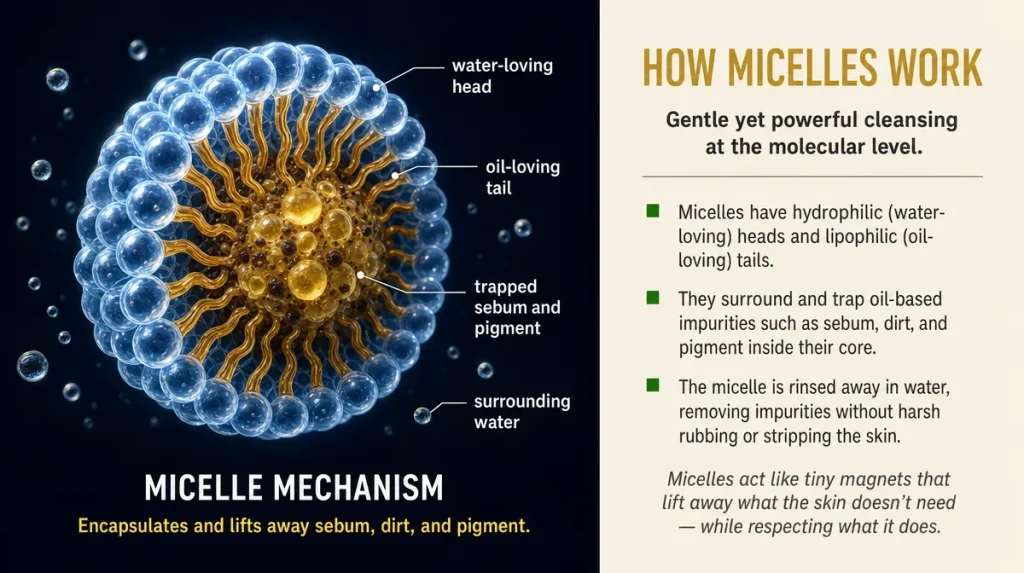
Micellar water is not a solvent in the way nail varnish remover is. It works through tiny clusters called micelles: a surfactant molecule has a water-loving head and an oil-loving tail, and in water these tails huddle together, facing inward, to form a tiny sphere with an oily centre and a watery surface. Sebum, sunscreen residue and make-up pigment are drawn into that oily core and held there, away from the skin, until the cotton pad carries them off.
The household version of this is washing-up liquid on a greasy pan. Water alone slides off fat; add a surfactant and the grease lifts into tiny globules the water can carry away. Micellar water does the same job at a gentler concentration, formulated to sit on skin rather than scald a baking tray.
A 2019 study in the International Journal of Cosmetic Science measured residual make-up on skin after micellar cleansing compared with rinse-off foaming cleansers, and found micellar formulas removed light make-up effectively in a single pass, but residue increased sharply with heavier, long-wear formulations. The researchers linked this to the finite number of micelles available in any given amount of product. In plain terms: the bottle holds a fixed supply of tiny grease-traps, and a full face of waterproof mascara can use them up before it reaches your jawline.
Patting Versus Rubbing: The Mistake That Undoes The Chemistry
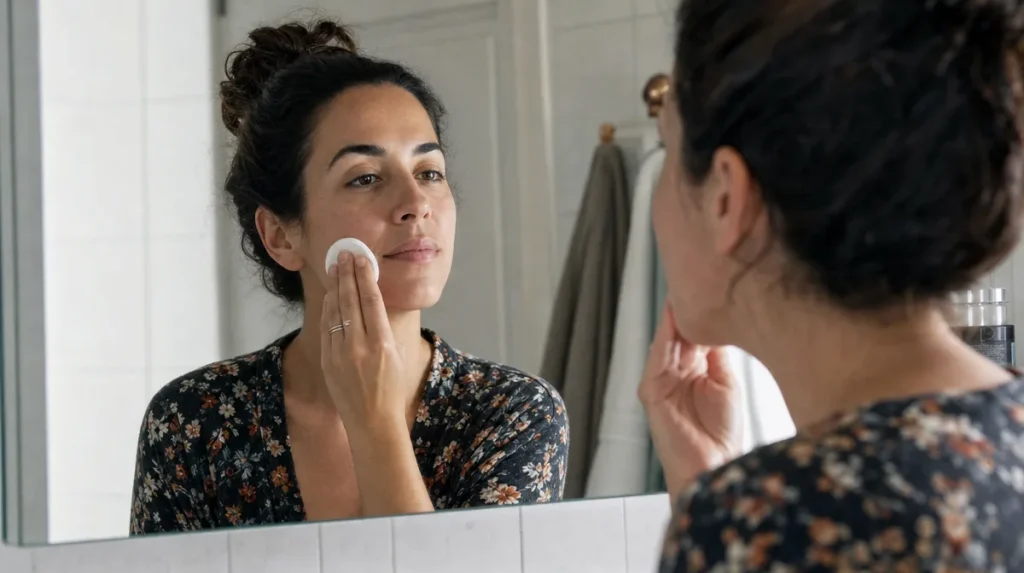
The instructions on most bottles say ‘wipe gently’, and most people read that as permission to scrub, especially on a tired night when the aim is simply to get to bed. Rubbing a cotton pad briskly across the cheeks does two unhelpful things. First, it drags trapped micelles back across skin that is already clean, redepositing some of what was just lifted. Second, repeated friction on skin that has not yet absorbed any moisture can roughen the surface layer, which is one reason people report tightness or flaking after a cleanse that was meant to be soothing.
The better method is closer to blotting than wiping. Soak the pad properly, press it against the skin for a few seconds to let the micelles work on stubborn areas such as the eye corners or nostril creases, then draw it across in one unhurried stroke rather than several short scrubbing motions. Turn the pad to a clean side for each pass rather than reusing a section already loaded with pigment and oil.
Good Housekeeping’s beauty desk has long advised treating eye make-up removal as a separate, slower step from the rest of the face, since the skin there is thinner and the friction tolerance lower. The same logic applies to the whole face on days when skin feels sensitised, whether from wind, a new retinol, or central heating drying out the air.
Why One Cleanse Often Isn’t Enough
Micellar water paired with SPF or heavier make-up often disappoints because people expect one pad to finish a job that always needed two. This is the single most common complaint about the category, and it is rarely the formula’s fault.
The practical fix is a second pass with a fresh pad, or a brief rinse-off cleanse afterwards if skin still feels filmy to the touch. Running a finger along the jawline after cleansing is a quick check: if it drags rather than glides, something is still sitting on the surface. SPF in particular is formulated to resist water and sweat, which is exactly what makes it resist a single swipe of micellar water too.
Judge results over a week rather than a single evening. A cleanser that leaves skin comfortable, without that tight, stripped sensation, and without a build-up of texture or dullness by day three or four, is doing its job. If breakouts appear specifically along the hairline or jaw after a week of use, the cause is more often incomplete removal than the product itself, meaning the fix is technique, not a different bottle.
What The Label Actually Tells You
The front of a micellar water bottle is marketing copy: cucumber, rose, ‘micro-biome friendly’, ‘detoxifying’. None of these terms has an agreed clinical meaning, and the Advertising Standards Authority has previously required brands to amend claims implying that cleansing could remove toxins from the body, since skin does not function as a filtration organ in that sense.
What is worth reading is the ingredient list on the back, specifically the surfactant used, usually something ending in ‘-eth’ or appearing as poloxamer or sodium cocoamphoacetate. Gentler, skin-identical surfactants tend to sit lower on the irritation scale used in dermatological patch testing. Fragrance-free is a more reliable indicator of comfort for sensitive or eczema-prone skin than any botanical extract, since fragrance remains one of the most common causes of contact reactions recorded by UK dermatology clinics.
pH is rarely printed but matters: skin sits around pH 4.5 to 5.5, and a cleanser formulated close to that range is less likely to disturb the surface barrier. Which? has previously tested cleansing products on comfort and residue rather than on brand claims, a useful reminder that a bottle’s own marketing is not the same as independent scrutiny. None of this means every fragranced product will cause problems. It means the safer bet, particularly for reactive skin, is the plainer-sounding bottle, not the one with the prettiest front label.
Matching The Formula To Your Skin, Not Your Mood
Micellar waters are not interchangeable across skin types, even though they often look identical in a clear bottle. Oilier skin generally tolerates and benefits from a formula with a slightly higher surfactant concentration, since there is more sebum to lift. Dry or dehydrated skin, especially through a damp British winter when central heating pulls moisture from the air, does better with a formula carrying humectants such as glycerin alongside the surfactant, so the cleanse does not leave a stripped feeling behind.
A simple patch test settles most doubts. Apply a small amount to the inner forearm, leave it for a few minutes, then check for redness or stinging before using it on the face. Marie Claire UK’s beauty pages have long recommended this basic check for any new cleansing product, not because micellar water carries particular risk, but because any surfactant can react differently on different skin.
For reactive or rosacea-prone skin, a short self-test while reading this is useful: cleanse one cheek as normal and leave the other with just a rinse of water. If the cleansed side feels tighter or looks pinker within ten minutes, the formula is likely too stripping for daily use on that skin, and a gentler alternative or shorter contact time is worth trying before abandoning the category altogether.
When Micellar Water Is The Wrong Tool For The Job
Micellar water earns its reputation on ordinary days: light make-up, no SPF, a quick cleanse before bed. It struggles with waterproof mascara, long-wear foundation and mineral sunscreen, all formulated specifically to resist the mild surfactant action micellar water provides.
On those days, the honest fix is an oil-based balm or cleansing oil first, followed by a water-based cleanser, the two-step method borrowed from Korean skincare routines and now standard advice across most UK beauty desks. Micellar water can still play a role here, as the lighter second step, but asking it to do the heavy lifting alone on a festival make-up day or after a long-wear foundation is asking a window cleaner’s cloth to strip paint.
The short, unreliable British summer means SPF is often a seasonal habit rather than a year-round one, which is worth knowing because the thicker, more water-resistant sunscreens worn on the handful of genuinely sunny days need more than a cotton pad to shift properly. A missed patch of sunscreen left on overnight is a common, avoidable cause of clogged pores and dull texture reported by readers who assumed their usual micellar routine was still doing the job it did in milder weather.
Keeping The Bottle Clean: Storage And Shelf Life
A bottle of micellar water left open on a steamy bathroom shelf is not shelf-stable forever, even with preservatives doing their job. Heat and repeated exposure to air both shorten its useful life, and a bottle kept near a radiator through a cold winter will degrade faster than one stored in a cupboard.
Dipping a used cotton pad back into the bottle, or pouring product over the open neck rather than away from it, introduces bacteria from face and hands into a bottle that will sit there for weeks. The simplest fix is to pour a small amount onto the pad away from the bottle’s mouth, never dip, and to use a smaller travel-size bottle, widely available at most high-street chemists, including Boots and Superdrug, if a full-size bottle is likely to sit unused for months.
Most brands print a period-after-opening symbol, a small open jar icon with a number and ‘M’ for months, usually somewhere between six and twelve. Treat that number as a real deadline, not a suggestion: a product well past its PAO symbol is more likely to irritate than cleanse effectively, regardless of how full the bottle still looks.
The Two-minute Test To Check You’re Using It Right
A quick way to judge whether your current routine is working is to cleanse as normal, wait two minutes, then press a clean, dry cotton pad firmly against your cheek and forehead for three seconds. Any colour transfer, whether it is foundation, SPF or simply a grey residue, means the first cleanse did not finish the job, and a second pass or a switch to double cleansing on heavier days is worth building into the routine.
Repeat the same check after your usual full routine, including moisturiser, once a week for a fortnight. If the pad consistently comes away clean, the method suits your skin and your make-up load. If it does not, the fix is nearly always technique or a second step, not a different bottle bought on offer at the next trip to the chemist. This small habit costs nothing and takes less time than scrolling through reviews for a replacement product that may face the identical problem.
Key Takeaways
Micellar water does one job: lifting oil and pigment into suspension so a pad can carry it away, not dissolving it like a solvent. Used with patience rather than pressure, matched to the right skin type, and followed by a second step on heavier make-up or SPF days, it remains one of the simplest cleansing steps in a routine. The common complaints, residue, tightness, breakouts along the jaw, nearly always trace back to technique or mismatch rather than a faulty bottle.
A Quick Checklist Before You Buy Or Restock
- Patch test any new formula on the inner forearm before using it on your face.
- Blot and press rather than scrub, turning the pad for each pass.
- Add a second cleanse on days with SPF, waterproof mascara or long-wear foundation.
- Check the period-after-opening symbol and treat it as a real deadline.
- Never dip a used pad back into the bottle.
- Run the two-minute pad test if you are unsure whether your routine is working.
This guide is general information, not medical advice; individual results vary.
Patch test new products and speak to a pharmacist or GP about any persistent skin reaction.