


Rajesh Kumar, Senior Health and Science Editor.
It is half past seven and you are leaning into the bathroom mirror, phone propped against the toothpaste, trying a fourth shade of concealer under an eye that did not get enough sleep. The drawer behind you holds at least three half-used tubes, each bought because an advert promised it would vanish the shadow for good. None of them quite did.
Here is the fact that explains most of that drawer: bathroom bulbs run warm, which means a shade that looks perfect under your own light can read orange or ashy the moment you step outside. Specialists do not start by comparing formulas. They start by controlling for light, skin texture and the specific job a concealer is being asked to do. This guide walks through exactly how they judge it, so you can do the same before you buy, not after.
- Shade comes before formula: the right tone matched against your jawline in daylight will outperform an expensive mismatched one every time.
- One concealer rarely suits both the eye area and a blemish: thinner textures belong under the eyes, denser ones on targeted redness.
- Creasing is usually a technique problem, not a product failure: how you prepare and set the skin matters more than the tube itself.
Finding Your Undertone In Daylight
Undertone is the muted colour sitting beneath your skin, cool, warm or neutral, and it is the single biggest reason a concealer either disappears or sits like a plaster. The problem is that most of us test shades indoors, under a bathroom light or a shop’s overhead spotlights, both of which distort colour the way a tinted window distorts paint swatches held against it.
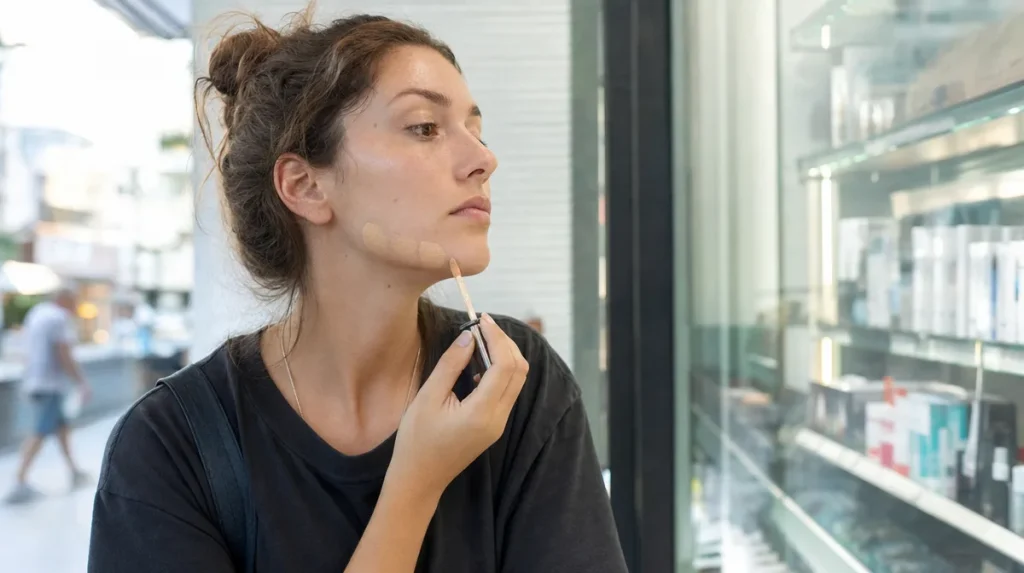
The fix is simple. Swatch a line of concealer along your jaw, not the back of your hand, which is often a shade or two different from your face. Then walk to a window, a doorway, or outside for a few seconds. If the swatch seems to vanish into your skin rather than sitting on top of it, you have found your shade.
The mistake most buyers make is trusting a single swatch on the inside of the wrist. Wrists run paler and cooler than most faces and will steer you towards the wrong tone almost every time.
Matching Texture To Where You Are Using It
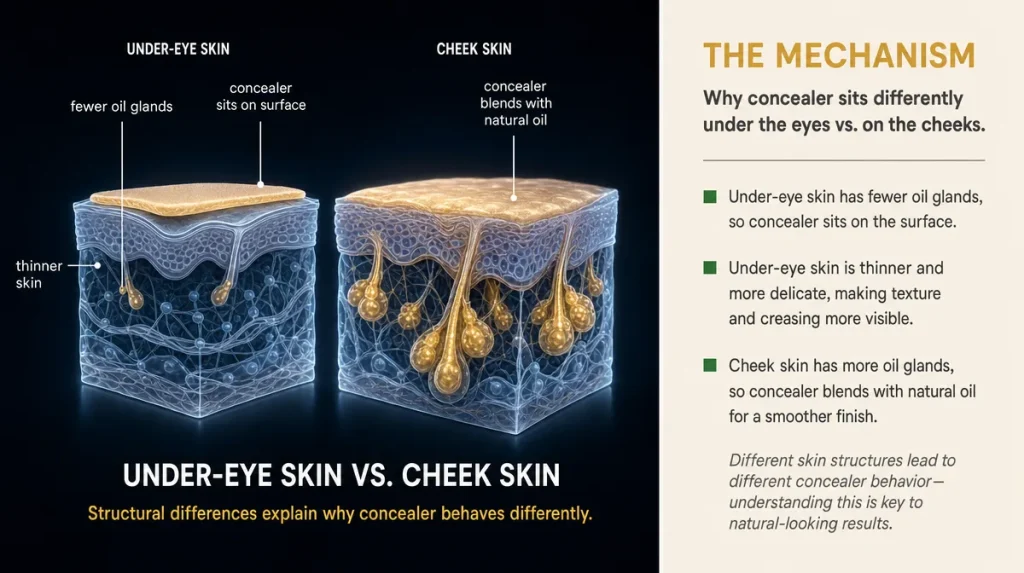
The skin under your eyes has far fewer oil glands than your cheeks or chin, which is why a rich, balm-like concealer that looks flawless on a blemish can sit in fine lines around the eye within an hour. Think of it like painting over a hairline crack in plaster: a thick gloss paint pools into the crack and draws attention to it, while a thin, flexible paint settles into the surface evenly.
For the eye area, a lightweight, slightly liquid formula that warms on contact with the skin will move with it rather than crack. For redness around the nose or a blemish on the cheek, a denser, higher-pigment formula gives better, longer-lasting coverage because that skin has more natural oil to blend it.
The common mistake is buying one concealer and using it everywhere. A 2021 study in the International Journal of Cosmetic Science found that perceived longevity of concealer varied significantly by facial zone, with under-eye application showing visibly faster breakdown than cheek application in the same subjects.
The Pinpoint Shade Test That Works In A Shop Aisle
Standing at a chemist counter with three tester shades can feel like guesswork, but there is a reliable trick. Draw a thin stripe of each shade from the jaw down onto the neck, where face meets neck is the point that matters, not the cheek. The shade that disappears into both is your match. If one shade vanishes on the jaw but shows up as a stripe on the neck, it will likely oxidise visibly by midday.
Do this test without rubbing the product in straight away. Give it thirty seconds. Many formulas shift slightly as they warm up, a process sometimes called oxidising, and a shade that looks right fresh can turn too warm or too pink once it settles.
If you are shopping somewhere like Boots or Superdrug, ask for testers rather than relying on packaging swatches, which are printed and do not reflect the true pigment.
Why Coverage Claims On The Label Mean Less Than You Think
“Full coverage”, “medium coverage” and “buildable” are marketing terms with no regulated definition, which means two products both labelled full coverage can perform very differently. What actually determines coverage is pigment concentration and particle size, neither of which appears on the front of the packaging.
A 2022 study published in the Journal of Cosmetic Science measured perceived coverage across several commercial concealers and found that consumer ratings correlated more closely with pigment load than with the coverage claim printed on the bottle. In plain terms, the label is not lying exactly, but it is not measuring anything consistent either.
The practical takeaway is to judge coverage with your own eyes on your own skin, ideally under daylight, rather than trusting the word on the tube. A concealer that needs two thin layers to cover a blemish is not necessarily worse than one that claims full coverage in one swipe. It may simply be more buildable, which for sensitive or textured skin is often the better outcome.
Why Concealer Creases, Cakes Or Goes Patchy
Creasing happens when concealer sits in a fine line and the moisture in the formula evaporates faster than the surrounding skin, leaving a visible ridge. It is the same reason a damp coat of paint cracks unevenly across a wall with an uneven surface: the thinnest, driest points fail first.
The fix starts before you apply anything. Moisturised skin holds concealer more evenly, so a hydrating base layer matters more than the concealer itself in damp British winters, when central heating draws moisture out of skin far more than cold air does. Apply concealer in thin layers, pressing rather than dragging it into place, and set only the areas that genuinely need it with a very light dusting of translucent powder.
The mistake nearly everyone makes is piling on more product to hide a shadow that is still showing through. More product without more moisture underneath simply gives the creasing more to cling to. Less, applied patiently, almost always looks better by lunchtime.
How Long Concealer Should Realistically Last Through A Day
No concealer is designed to look exactly as it did at 8am by 6pm, and specialists judge longevity by how gracefully it fades rather than whether it fades at all. Oils naturally produced by your skin break down pigment over several hours, which is normal and not a sign of a faulty product.
The Good Housekeeping Institute’s general guidance on testing make-up longevity recommends checking products at several points across a working day rather than relying on first impressions, a sensible habit for anyone choosing between formulas. Try checking your own concealer at midday and again at 5pm under the same light each time, ideally near a window.
Seasonal conditions matter too. A short, unreliable British summer means skin often runs oilier only for a few weeks a year, while damp winters and central heating dry it out for months at a time, which changes how any concealer wears. What looks patchy in January may simply need a different base routine, not a different concealer entirely.
Ingredients Worth Knowing, And The Marketing Noise To Ignore
A handful of ingredients genuinely affect how concealer behaves. Hyaluronic acid helps the formula hold moisture, which may reduce the dry, cakey look in fine lines. Silicones create the smooth, blurred finish many people want, though they can feel heavy on very oily skin. Mineral pigments tend to sit more naturally than synthetic dyes and may suit sensitive skin better, though results vary by individual.
Much of the rest is noise. Phrases like “infused with diamond dust” or “enriched with gold” describe inclusions present in amounts too small to meaningfully change performance, and they exist to justify a premium price rather than to improve coverage. The British Beauty Council has published reports calling for clearer ingredient communication across the industry, noting that consumers are often unable to distinguish active ingredients from decorative marketing language on packaging.
When reading a label, look near the top of the ingredient list, where concentrations are highest, rather than trusting the claims printed in large type on the front of the box.
Judging Whether A Concealer Is Actually Working For You
The clearest test is a photograph, not a mirror. Mirrors flatter in ways phone cameras do not, so take an unfiltered photo in natural daylight after application, then another six hours later in the same spot. Compare the two for creasing around the eye, patchiness on the nose, and whether the shade has shifted warmer or cooler.
If a concealer fails this test consistently, the issue is usually one of the three things covered above: wrong undertone, wrong texture for the area, or insufficient preparation underneath. It is rarely the brand’s fault alone.
Worth noting too that concealer, like most cosmetics, has a practical shelf life. General guidance from product-testing bodies such as the Good Housekeeping Institute suggests most liquid concealers are best used within six to twelve months of opening, after which texture and pigment can both degrade. A concealer that performed well for months and suddenly stopped working may simply be past its best.
Key Takeaways
Getting concealer right is less about finding a miracle formula and more about matching three things correctly: your undertone, the texture to the area you are covering, and your preparation underneath. Specialists judge a concealer by how it behaves across a full day in daylight, not by how it looks in the first five minutes under shop lighting.
A Quick Checklist Before You Buy
- Swatch along the jaw and check it in daylight, not under indoor bulbs.
- Use a lighter texture under the eyes and a denser one on blemishes or redness.
- Moisturise before applying, and set only where creasing tends to happen.
- Check your results at midday and again in the late afternoon.
- Read the ingredient list near the top rather than trusting front-of-pack claims.
- Replace concealer every six to twelve months once opened.
This article is for general information and does not replace personal advice from a dermatologist or pharmacist.
Individual results vary depending on skin type, application and storage conditions.