

Daniel Osei, Staff Writer.
You are standing in front of the bathroom shelf again, the one crowded with bottles you tried once and never finished. Somewhere in that crowd is the scent you actually reach for, and behind it are four or five you bought because a name sounded right, or because an assistant sprayed a card and you liked it there and then. The question that actually brings people here is not which perfume is best, but a quieter one: how do I stop buying bottles I regret. Here is a useful fact to start with. A fragrance’s strength category, eau de parfum against eau de toilette, tells you almost nothing about how long it will last on your particular skin. Skin chemistry, moisture levels, even what you ate at lunch, all change how a scent behaves once it warms up. This guide sets out what the label can genuinely tell you, what counts as marketing dressing, and how to test and judge a scent properly before it comes home with you.
- Concentration is a guide, not a guarantee: the percentage of fragrance oil on the label shifts longevity in general, but skin chemistry decides the rest.
- A scent you smell in the first minute is not the scent you will wear all day: judge it only after it has warmed on your skin for twenty minutes or more.
- Storage does more damage than time: heat, light and bathroom humidity break a fragrance down faster than simply keeping a bottle for a few years.
Reading The Strength On The Label
Eau de parfum, eau de toilette and parfum extrait describe the proportion of fragrance oil dissolved in alcohol and water, roughly 15 to 20 per cent for eau de parfum, less for eau de toilette, more for extrait. Think of it like squash concentrate. A stronger concentrate needs less topping up, but it will not automatically taste better, only stronger and, usually, longer lasting.
The mistake is assuming a higher percentage always means a superior scent. It means a higher dose of the same formula, nothing more. A poorly blended eau de parfum will still smell poorly blended, just for longer.
Which?, the consumer body that has tested household products since 1957, has pointed out in its general guidance that longevity claims on packaging rarely match real-world wear, since humidity, skin oil and even central heating all interfere. A simple self-test: spray the same fragrance family in both an eau de toilette and an eau de parfum strength on opposite wrists, then compare at the four-hour mark rather than immediately.
Why A Scent Changes Over The Hours You Wear It
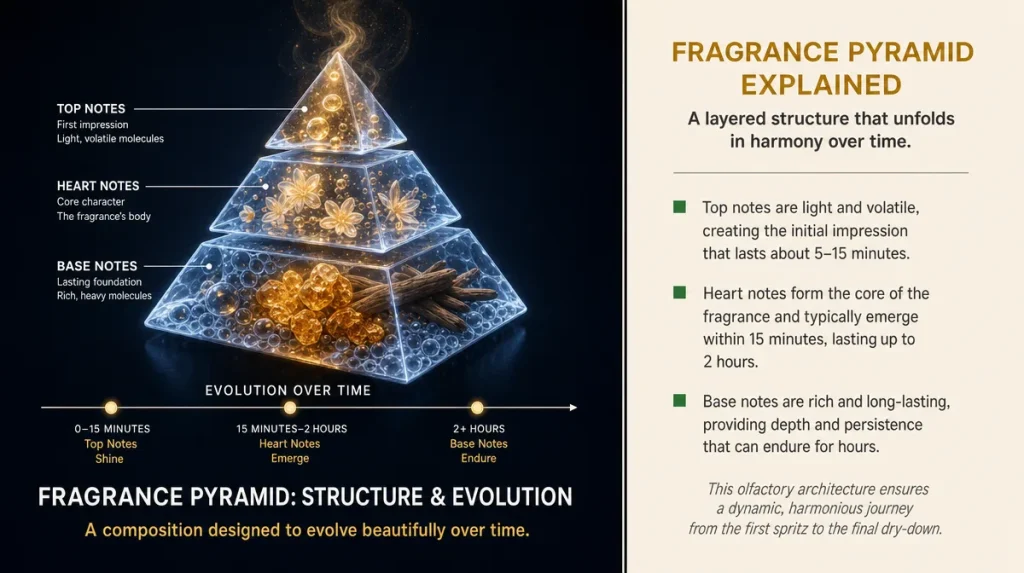
Every fragrance is built in three layers, commonly called top, heart and base notes. Lighter molecules, often citrus or herbal, evaporate first and vanish within fifteen to thirty minutes. Heavier molecules, woods, musks, ambers, take longer to reveal themselves and can still be present eight hours later.
The household analogy that works best is a three-course meal. The starter disappears quickly and is meant to. The main course is what you actually remember eating. Judging a fragrance by its opening minute is like reviewing a restaurant on the bread basket alone.
A 2019 study in the Journal of Sensory Studies, working with a panel of 42 participants, found that perceived pleasantness of a fragrance shifted significantly between the ten-minute and two-hour marks, often in a more favourable direction as the base notes settled. The practical lesson: smell the paper strip if you like, but do not decide anything from it. Spray on skin, wait, and smell again at twenty minutes, then again after an hour if you can manage it.
Testing A Fragrance Before You Commit

The counter test most people do, a quick sniff of a paper strip, only captures the top notes described above. A proper test means spraying on skin, ideally the inside of the wrist or the inner elbow, and giving it time to warm.
A common mistake is testing five or six fragrances in one visit. The nose adapts quickly to repeated exposure, a process called olfactory fatigue, and by the fourth scent everything starts to smell vaguely similar. Testing no more than two or three at a time, with a break for fresh air between them, gives a fairer read.
If you can, apply the test spray before running other errands, then notice it again an hour or two later without deliberately trying to smell it. That unprompted moment, catching a trace of it on your coat, tells you more about whether you would want to live with the scent than any amount of careful sniffing at a counter.
Sorting Marketing Language From What Is In The Bottle
Words like natural, clean and pure appear on packaging with no fixed legal meaning in cosmetics, and can be applied almost as freely as a brand chooses. What does carry weight is the allergen labelling now required under UK cosmetics regulation, which lists specific fragrance allergens by name once they exceed a set concentration, useful information if you have sensitive skin or a known reaction to a particular compound.
The British Beauty Council, which represents the industry and publishes policy reports on transparency, has noted the gap between how fragrances are marketed and how little consumers typically know about formulation. That gap is not unique to any one brand, it is closer to how the whole category is written.
A more useful filter than the front-of-bottle language is checking whether the ingredient list on the box names actual allergens rather than relying on vague copy alone. If a description leans heavily on story, inspiration and mood, and says nothing concrete about composition, treat it as marketing rather than information.
Judging How Long It Lasts And How Far It Travels
Longevity and sillage are two different things and get confused constantly. Longevity is how long you can still detect the scent on your own skin. Sillage, from the French word for wake, is how far it projects and how noticeable it is to someone standing near you.
A fragrance can have excellent longevity and almost no sillage, sitting close to the skin for hours, or the reverse, filling a room for the first thirty minutes and then fading fast. Neither is better, they simply suit different situations, an office desk against an evening out.
The way product panels at institutions like the Good Housekeeping Institute typically structure a trial, checking at set intervals rather than relying on one impression, is worth borrowing at home. Spray, then check consciously at two hours, four hours and eight hours, noting whether you can still smell it on your own skin without leaning in. Ask someone else, at arm’s length, whether they can smell it unprompted. That single question does more to establish sillage than any amount of solo sniffing.
Storing A Bottle So It Doesn’t Turn
Fragrance oils oxidise, and heat, light and humidity all speed the process along. A bathroom cabinet, warm and damp from every shower, is close to the worst place to keep a bottle, however convenient it feels each morning.
A cool, dark drawer, ideally with the original box left on, slows the process considerably. Direct sunlight through a window is particularly harsh, changing both colour and scent within weeks in bad cases.
A fragrance that has turned often smells slightly sour, or loses its top notes entirely and jumps straight to something flat and base-heavy. If a bottle you have owned for years suddenly smells wrong, storage is the likelier culprit before you assume the formula was reformulated.
Because testing at home matters so much, it is worth buying smaller sizes first, whether from a high-street chemist, Boots, Superdrug or a Marks and Spencer beauty hall, rather than committing to a full bottle on a single counter test. Larger bottles are often better value when they come on offer, and around Boxing Day in particular, when many readers do their annual restocking rather than during the more heavily marketed autumn sales.
Layering Without Overwhelming A Room
Layering, using a matching scented body lotion or shower gel underneath a fragrance, works because it builds a base coat of the same notes rather than introducing something new to compete with. Think of it like adding stock to a soup: more of the same flavour deepens it, a different stock muddies it.
The common error is layering two unrelated fragrance families, a citrus body wash under a heavy amber perfume, for instance. Rather than reinforcing each other, they clash, and the result reads as muddled rather than rich.
A simple self-test: apply an unscented moisturiser as your base, then the fragrance on top, and compare that to a day when you use a matching scented lotion underneath the same perfume. Most people notice the matched layering lasts visibly longer and feels more coherent, without needing to reapply through the day.
Choosing For The Season Without Buying Twice
Fragrance reads differently depending on temperature and humidity, which is why a scent adored in December can feel heavy and cloying by June. Warmer skin releases fragrance molecules faster, which is partly why lighter, citrus-forward compositions tend to suit a British summer, however short and unreliable it usually turns out to be.
Damp winters and central heating dry the skin more than the cold itself does, and drier skin tends to hold fragrance less well, which is one practical reason heavier, richer compositions are often chosen for winter: they have more to hold onto and more presence to compensate.
Rather than buying an entirely new bottle each season, many people keep two, a lighter everyday scent and a richer one for colder months and evenings, rotating rather than replacing. It is a cheaper habit in the long run than repeatedly buying a full bottle that only suits half the year.
Key Takeaways
A fragrance’s concentration tells you about strength and rough duration, not about quality. The real test happens on skin, over hours, not on a paper strip in a shop. Storage conditions change a bottle’s lifespan more than the calendar does, and layering only works when the notes agree rather than compete. Season and skin condition both alter how a scent performs, so the same bottle can behave quite differently in January and July.
A Quick Checklist Before You Buy
- Test on skin, not paper, and wait at least twenty minutes before judging
- Limit yourself to two or three scents per visit to avoid nose fatigue
- Check the ingredient list for named allergens rather than trusting front-of-bottle language
- Ask someone at arm’s length whether they can smell it, to judge sillage honestly
- Store the bottle in a cool, dark drawer, not a warm bathroom cabinet
- Buy a small size first if you are unsure, and consider larger bottles when they are on offer
This article is general information and is not a substitute for testing a fragrance on your own skin.
Individual results vary depending on skin chemistry and storage conditions.